Dr. Ben Mather

Dr. Ben Mather

ARC Industry Research Fellow

I am an ARC Industry Research Fellow in the School of Geography, Earth and Atmospheric Sciences at The University of Melbourne. I am an expert in fusing Earth evolution models with data to understand how groundwater moves critical minerals through the landscape. Related research interests include the cycling of volatiles within the Earth, probabilistic thermal models of the lithosphere to unravel past tectonic and climatic events, and understanding the how enigmatic volcanoes form.

I am a vocal advocate for the integral role of geoscience in responding to challenges we face in transitioning to the carbon-neutral economy. As an expert in my field, I have been interviewed in national and international print media, TV, and radio on a wide variety of subjects including earthquakes, volcanoes, groundwater, and critical minerals.

Unravelling the origins of enigmatic volcanism to discover critical metals featured image

Unravelling the origins of enigmatic volcanism to discover critical metals

This talk explores the origins of enigmatic intraplate volcanism that occurs far from plate boundaries, and its implications for discovering critical metal deposits. By integrating …

avatar
Dr. Ben Mather
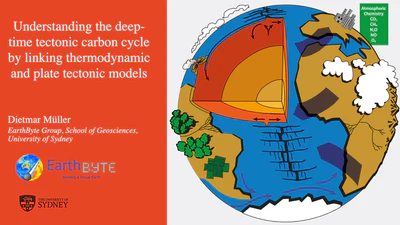
Understanding the deep-time tectonic carbon cycle by linking thermodynamic and plate tectonic models featured image

Understanding the deep-time tectonic carbon cycle by linking thermodynamic and plate tectonic models

This talk examines the deep-time tectonic carbon cycle by linking thermodynamic models of carbon storage and release with global plate tectonic reconstructions. We quantify carbon …

avatar
Dr. Ben Mather
Subducting seafloor anomalies promote porphyry copper emplacement featured image

Subducting seafloor anomalies promote porphyry copper emplacement

“Porphyry copper deposits are critical for the energy transition, yet no significant discoveries have been made in the last decade. We investigate how subducting seafloor …

avatar
Dr. Ben Mather
What kept Earth frozen for 57 million years? featured image

What kept Earth frozen for 57 million years?

A new paper in Geology links the duration of the Sturtian Snowball Earth glaciation to exceptionally low CO2 outgassing from mid-ocean ridges — not volcanic arcs.

avatar
Dr. Ben Mather
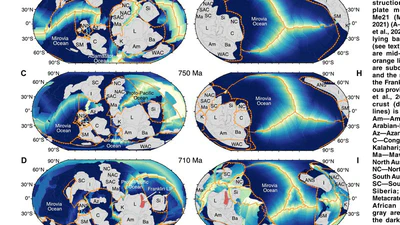
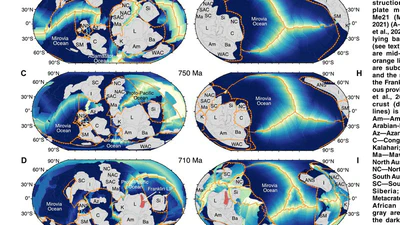
Duration of Sturtian 'Snowball Earth' glaciation linked to exceptionally low mid-ocean ridge outgassing featured image

Duration of Sturtian 'Snowball Earth' glaciation linked to exceptionally low mid-ocean ridge outgassing

Exceptionally low mid-ocean ridge CO2 outgassing sustained the Sturtian Snowball Earth glaciation for over 50 million years.

avatar
Adriana Dutkiewicz
Flexural isostatic response of continental-scale deltas to climatically driven sea level changes featured image

Flexural isostatic response of continental-scale deltas to climatically driven sea level changes

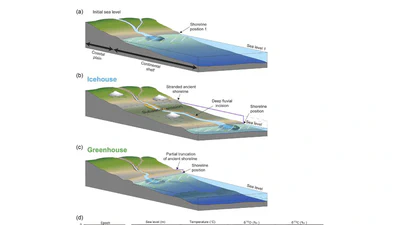
Simulating how flexural isostatic responses to climatically driven sea level changes shape continental-scale delta evolution on passive margins.

avatar
Sara Polanco
Determining subsurface temperature & lithospheric structure from joint geophysical-petrological inversion: A case study from Ireland featured image

Determining subsurface temperature & lithospheric structure from joint geophysical-petrological inversion: A case study from Ireland

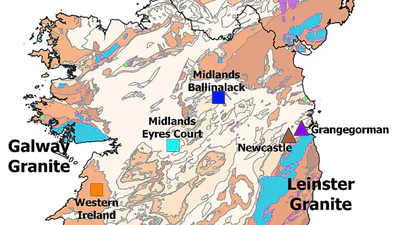
A joint geophysical-petrological inversion combining seismic surface-wave data with thermodynamic modelling to map subsurface temperature in Ireland.

avatar
Emma L. Chambers
UTas Maydena workshop featured image

UTas Maydena workshop

Workshop presentation at the University of Tasmania exploring geodynamic and geophysical research themes relevant to the geology of Tasmania and southeastern Australia.

avatar
Dr. Ben Mather
Go with the flow featured image

Go with the flow

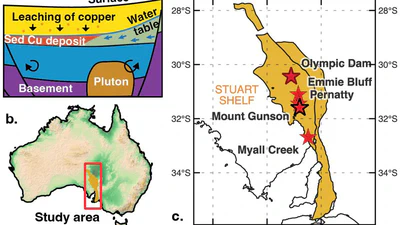
Tracing ancient groundwater pathways to discover copper

avatar
Dr. Ben Mather
Global Hydrogen Production During High-Pressure Serpentinization of Subducting Slabs featured image

Global Hydrogen Production During High-Pressure Serpentinization of Subducting Slabs

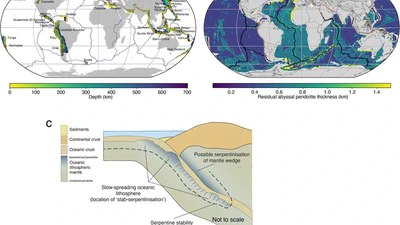
Quantifying global hydrogen production from high-pressure serpentinisation of subducting slabs over the last 5 million years.

avatar
Andrew S. Merdith