Water in the mantle
Subducting slabs transport water deep into the mantle, where it is stored within minerals such as ringwoodite and wadsleyite in the mantle transition zone. We predict the influx of …


I am an ARC Industry Research Fellow in the School of Geography, Earth and Atmospheric Sciences at The University of Melbourne. I am an expert in fusing Earth evolution models with data to understand how groundwater moves critical minerals through the landscape. Related research interests include the cycling of volatiles within the Earth, probabilistic thermal models of the lithosphere to unravel past tectonic and climatic events, and understanding the how enigmatic volcanoes form.
I am a vocal advocate for the integral role of geoscience in responding to challenges we face in transitioning to the carbon-neutral economy. As an expert in my field, I have been interviewed in national and international print media, TV, and radio on a wide variety of subjects including earthquakes, volcanoes, groundwater, and critical minerals.
Subducting slabs transport water deep into the mantle, where it is stored within minerals such as ringwoodite and wadsleyite in the mantle transition zone. We predict the influx of …
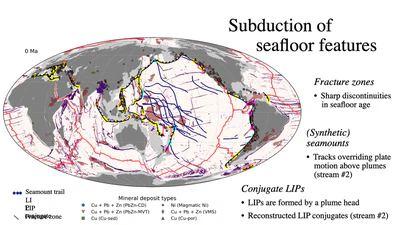
We examine the spatial relationship between subducting seafloor features—fracture zones, seamount chains, and large igneous provinces—and the distribution of porphyry copper …
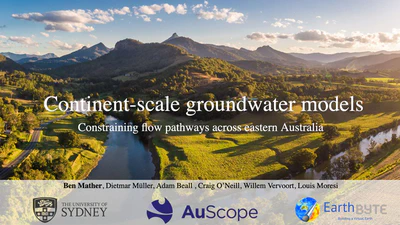
“We present a continent-scale groundwater flow model for eastern Australia that eliminates the need for prescribed side boundary conditions by simulating the entire basin system. …
Large igneous provinces repeatedly form where mantle plumes intersect mid-ocean ridges, yet the dynamics of plume-ridge interaction remain poorly understood. We investigate how the …
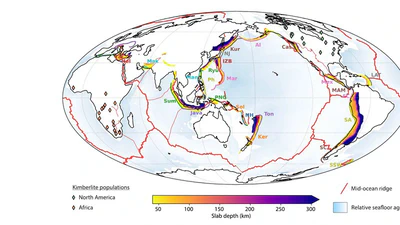
Machine learning reveals that the volume and angle of subducted oceanic plates control where and when diamond-bearing kimberlite eruptions occur.
Mantle plumes and mid-ocean ridges interact in ways that influence both plate motion and volcanism, yet these dynamics are poorly captured in existing plate tectonic models. We …
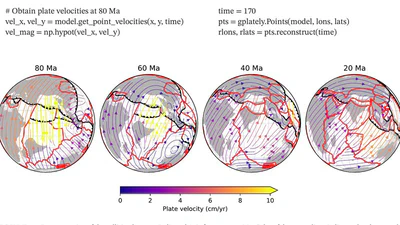
GPlately: a Python interface for deep-time spatio-temporal data analysis using pyGPlates, simplifying plate tectonic reconstructions.
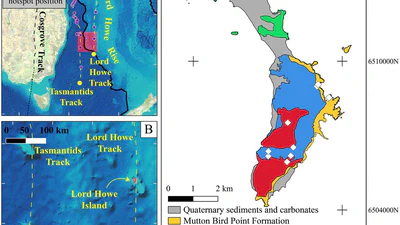
First radiogenic isotope data from Lord Howe Island lavas reveal a secondary mantle plume twin in the Tasman Sea with a distinct deep mantle source.

GPlately is an open-source Python package built on pyGPlates that accelerates spatio-temporal data analysis for plate tectonic reconstructions. It provides a simplified, …
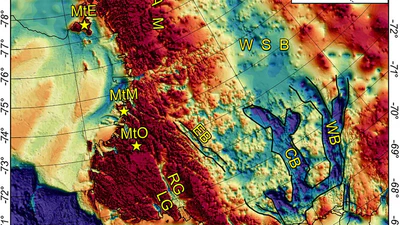
Curie depth estimates from airborne magnetic data reveal anomalously high geothermal heat flow beneath the Transantarctic Mountains and Wilkes Subglacial Basin.
