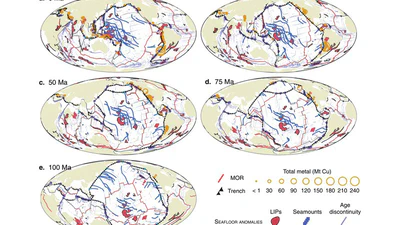
Subducting seafloor anomalies promote porphyry copper formation
Plate tectonic reconstructions and machine learning show that subducting seafloor anomalies promote porphyry copper deposit formation.


Plate tectonic reconstructions and machine learning show that subducting seafloor anomalies promote porphyry copper deposit formation.
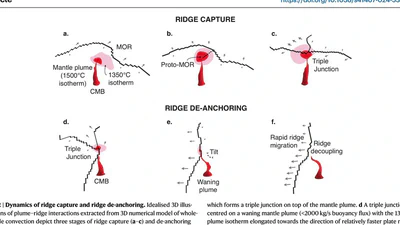
Numerical modelling shows that high-buoyancy mantle plumes can capture and de-anchor spreading ridges, enabling their migration over vast distances.
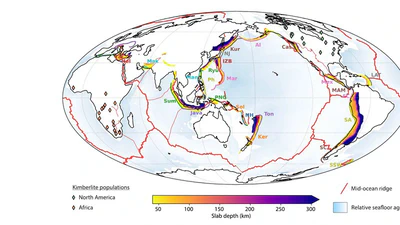
Machine learning reveals that the volume and angle of subducted oceanic plates control where and when diamond-bearing kimberlite eruptions occur.
Mantle plumes are buoyant upwellings rising from the Earth’s core-mantle boundary to its surface, generating hotspot chains that track the direction of plate motion. Eastern …

Deep mantle plumes are buoyant upwellings rising from the Earth’s core-mantle boundary to its surface, and describing most hotspot chains. Mechanisms to explain dual chains of …
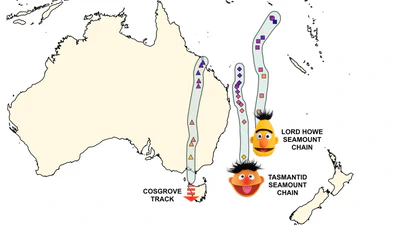
We propose that slab-induced plume branching can explain the formation of parallel hotspot chains observed in the oceanic and continental record. Using plate tectonic …

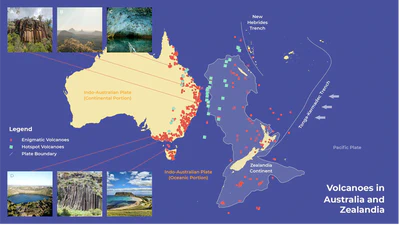
Long-lived, widespread intraplate volcanism without age progression is one of the most controversial features of plate tectonics. The eastern margin of Australia and Zealandia has …
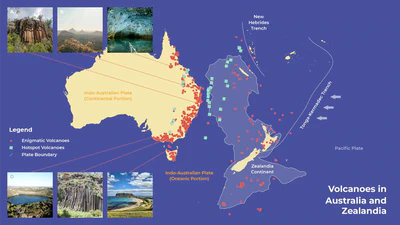
Modelling 100 million years of subducted slab volume reveals that bursts in slab flux trigger intraplate volcanism in eastern Australia.

Eruption and disuption: how Earth's deep interior and surface communicate
