R. Dietmar Müller

R. Dietmar Müller

Professor of Geophysics
Dietmar Müller leads the EarthByte Group and is a Fellow of the Australian Academy of Science. His research focuses on plate tectonics, geodynamics, and the development of the GPlates software for producing open-access models of Earth’s dynamic history.
Carbon emissions along divergent plate boundaries modulate icehouse-greenhouse climates featured image

Carbon emissions along divergent plate boundaries modulate icehouse-greenhouse climates

Carbon emissions along divergent plate boundaries modulate icehouse-greenhouse climate transitions through mid-ocean ridge and rift degassing.


avatar
Dr. Ben Mather
Craton boundary detection from full-waveform tomography model reveals links to critical metal deposits featured image

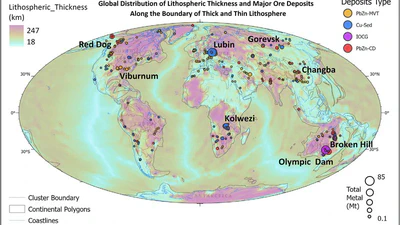
Craton boundary detection from full-waveform tomography model reveals links to critical metal deposits

Using full-waveform seismic tomography to detect craton boundaries and their spatial links to critical metal deposit locations.

avatar
Hojat Shirmard
Regional carbonate compensation depth variability in the Pacific Ocean since the Oligocene featured image

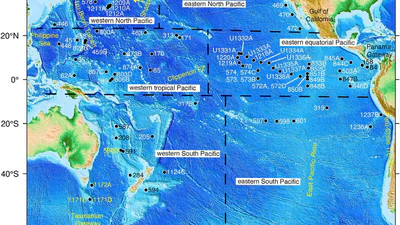
Regional carbonate compensation depth variability in the Pacific Ocean since the Oligocene

Reconstructing regional carbonate compensation depth variability in the Pacific Ocean since the Oligocene to understand deep-sea carbon cycling.
Faranak Dalvand
Subducting seafloor anomalies promote porphyry copper formation featured image

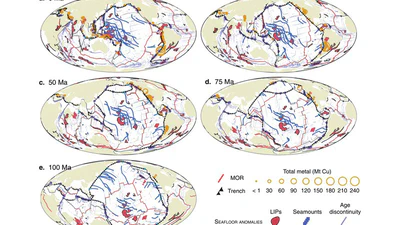
Subducting seafloor anomalies promote porphyry copper formation

Plate tectonic reconstructions and machine learning show that subducting seafloor anomalies promote porphyry copper deposit formation.
avatar
Dr. Ben Mather
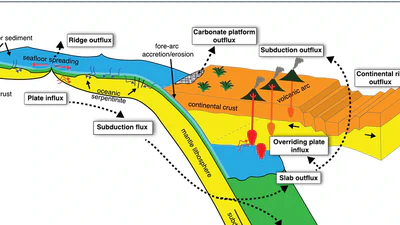
Solid Earth Carbon Degassing and Sequestration Since 1 Billion Years Ago featured image

Solid Earth Carbon Degassing and Sequestration Since 1 Billion Years Ago

Coupling plate tectonic models with thermodynamic carbon outflux estimates to reconstruct solid Earth carbon degassing over the last billion years.

avatar
R. Dietmar Müller
Spatio-temporal copper prospectivity in the American Cordillera predicted by positive-unlabeled machine learning featured image

Spatio-temporal copper prospectivity in the American Cordillera predicted by positive-unlabeled machine learning

A positive-unlabeled machine learning model predicts spatio-temporal copper prospectivity along the American Cordillera from subduction zone dynamics.

avatar
Christopher P. Alfonso
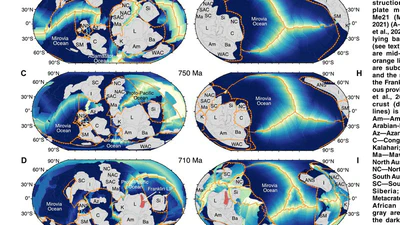
Duration of Sturtian 'Snowball Earth' glaciation linked to exceptionally low mid-ocean ridge outgassing featured image

Duration of Sturtian 'Snowball Earth' glaciation linked to exceptionally low mid-ocean ridge outgassing

Exceptionally low mid-ocean ridge CO2 outgassing sustained the Sturtian Snowball Earth glaciation for over 50 million years.

avatar
Adriana Dutkiewicz
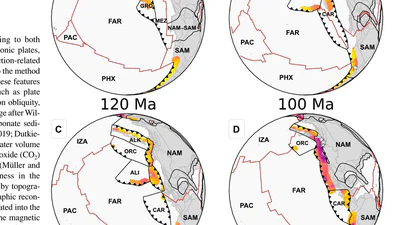
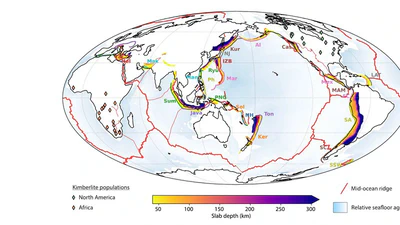
Kimberlite eruptions driven by slab flux and subduction angle featured image

Kimberlite eruptions driven by slab flux and subduction angle

Machine learning reveals that the volume and angle of subducted oceanic plates control where and when diamond-bearing kimberlite eruptions occur.
avatar
Dr. Ben Mather
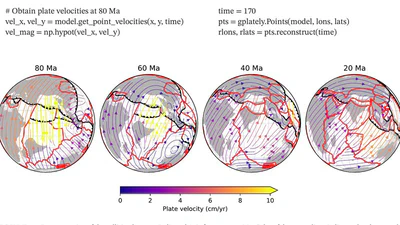
Deep time spatio-temporal data analysis using pyGPlates with PlateTectonicTools and GPlately featured image

Deep time spatio-temporal data analysis using pyGPlates with PlateTectonicTools and GPlately

GPlately: a Python interface for deep-time spatio-temporal data analysis using pyGPlates, simplifying plate tectonic reconstructions.
avatar
Dr. Ben Mather
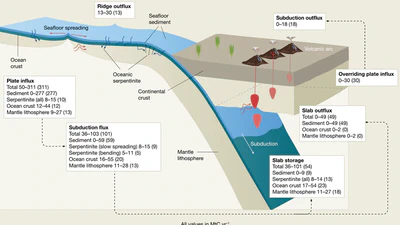
Evolution of Earth’s tectonic carbon conveyor belt featured image

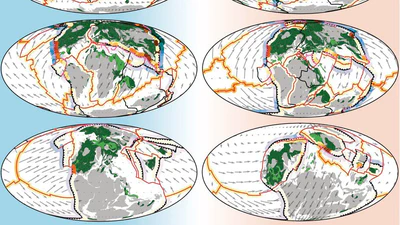
Evolution of Earth’s tectonic carbon conveyor belt

Reconstructing the oceanic carbon conveyor belt over 250 million years reveals plate tectonics as a pivotal driver of Mesozoic climate change.

avatar
R. Dietmar Müller