What kept Earth frozen for 57 million years?

 Reconstruction of mid-ocean ridge outgassing during the Sturtian Snowball Earth glaciation.
Around 717 million years ago, the Earth entered the most extreme ice age in its history. Ice sheets may have extended all the way to the equator, and the planet stayed frozen for an extraordinary 57 million years. What triggered this global deep freeze — and what kept it going for so long?
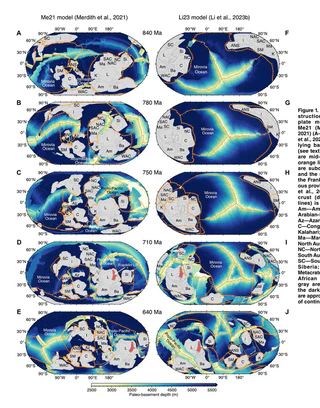
In our new paper in Geology, we use two independent Neoproterozoic plate tectonic models to test whether plate tectonics can explain the Sturtian glaciation.
It wasn’t the arcs
The most widely debated explanations involve weathering of the Franklin large igneous province and changes in continental arc volcanism. But our analysis shows that continental arc length remained relatively constant from 850 Ma through the end of the glaciation — ruling it out as a driver.
It was the ridges
Instead, the plate tectonic models reveal that mid-ocean ridge CO2 outgassing dropped to exceptionally low levels around the onset of the glaciation. One model predicts outgassing and sea level lower than during the Late Cenozoic glaciation — starving the atmosphere of the greenhouse gas needed to keep the planet warm.
The combination of very low ridge outgassing and enhanced weathering from the Franklin LIP likely tipped Earth into a snowball state. Once frozen, reduced silicate weathering meant CO2 slowly accumulated from ongoing volcanism until, 57 million years later, greenhouse warming finally melted the ice.
Reference: Dutkiewicz, A., Merdith, A.S., Collins, A.S., Mather, B., Ilano, L., Zahirovic, S. & Müller, R.D. (2024). Duration of Sturtian ‘Snowball Earth’ glaciation linked to exceptionally low mid-ocean ridge outgassing. Geology. doi:10.1130/G51669.1

I am an ARC Industry Research Fellow in the School of Geography, Earth and Atmospheric Sciences at The University of Melbourne. I am an expert in fusing Earth evolution models with data to understand how groundwater moves critical minerals through the landscape. Related research interests include the cycling of volatiles within the Earth, probabilistic thermal models of the lithosphere to unravel past tectonic and climatic events, and understanding the how enigmatic volcanoes form.
I am a vocal advocate for the integral role of geoscience in responding to challenges we face in transitioning to the carbon-neutral economy. As an expert in my field, I have been interviewed in national and international print media, TV, and radio on a wide variety of subjects including earthquakes, volcanoes, groundwater, and critical minerals.