How mantle plumes steer spreading ridges

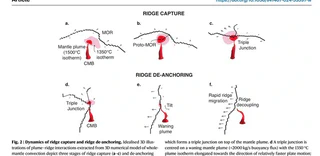 Numerical model showing plume-ridge interaction and de-anchoring of the SE Indian Ridge.
Mid-ocean ridges are not fixed — over millions of years they can migrate thousands of kilometres across ocean basins. The conventional explanation is that asymmetric slab pull forces drag ridges toward the stronger subduction zone. But that picture is incomplete.
In our new paper in Nature Communications, we use numerical models of mantle convection to show that mantle plumes play a previously unrecognised role in controlling ridge position.
Plume anchoring and de-anchoring
- Plumes with high buoyancy flux (>3000 kg/s) can capture a spreading ridge within a 1000 km radius and hold it in place.
- Exceptionally strong plumes may even fragment the overriding plate into smaller plates to accommodate more efficient plate motion.
- When the plume weakens below ~1000 kg/s, the ridge is de-anchored and can migrate rapidly under the influence of asymmetric plate boundary forces.
Application to the SE Indian Ridge
We apply this mechanism to explain the rapid migration of the Southeast Indian Ridge starting around 43 million years ago. As the Kerguelen plume’s buoyancy flux waned, it released the ridge, triggering a phase of fast migration that reshaped the Indian Ocean basin.
This plume-ridge de-anchoring mechanism has broad implications for understanding why spreading ridges sometimes shift abruptly after long periods of stability — and may help explain the formation of large igneous provinces and asymmetric seafloor spreading worldwide.
Reference: Mather, B., Seton, M., Williams, S., Whittaker, J., Carey, R., Arnould, M., Coltice, N. & Duncan, R. (2024). Spreading ridge migration enabled by plume-ridge de-anchoring. Nature Communications. doi:10.1038/s41467-024-53397-w

I am an ARC Industry Research Fellow in the School of Geography, Earth and Atmospheric Sciences at The University of Melbourne. I am an expert in fusing Earth evolution models with data to understand how groundwater moves critical minerals through the landscape. Related research interests include the cycling of volatiles within the Earth, probabilistic thermal models of the lithosphere to unravel past tectonic and climatic events, and understanding the how enigmatic volcanoes form.
I am a vocal advocate for the integral role of geoscience in responding to challenges we face in transitioning to the carbon-neutral economy. As an expert in my field, I have been interviewed in national and international print media, TV, and radio on a wide variety of subjects including earthquakes, volcanoes, groundwater, and critical minerals.