A billion-year carbon budget for the solid Earth

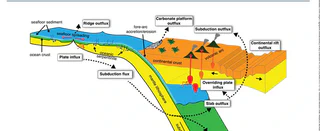 Solid Earth carbon degassing and sequestration since 1 billion years ago.
Over the last billion years, the Earth’s climate has swung between extreme ice ages and hothouse conditions. A major driver of these shifts is the balance between CO2 released by volcanic and tectonic processes and carbon locked away into oceanic plates. But quantifying these fluxes in deep time has remained a major challenge.
In our new paper in Geochemistry, Geophysics, Geosystems, we build the most comprehensive model yet of solid Earth carbon emissions and sequestration over the past billion years.
How we did it
We coupled a plate tectonic model with reconstructions of carbon stored in oceanic plates and a thermodynamic model of what happens when those plates are subducted. This lets us track the balance between CO2 released at mid-ocean ridges, rifts, and volcanic arcs, and carbon locked into oceanic sediments and crust.
Key findings
- A peak in crustal production and net outgassing from 840 to 780 Ma in the early Neoproterozoic corresponds to a pulse of large igneous province eruptions.
- The Sturtian and Marinoan Snowball Earth glaciations (717–635 Ma) coincide with a low in mid-ocean ridge outgassing.
- The following Ediacaran global warming aligns with a rise in net atmospheric carbon influx, driven by increasing plate boundary and rift length.
- Hothouse climates in the Cambrian, Silurian/Devonian, and Triassic-Jurassic align with reduced carbon sequestration into oceanic plates.
- The late Cenozoic cooling trend correlates with declining ridge and rift degassing alongside a surge in carbon burial in deep-sea sediments.
These results provide new boundary conditions for understanding how plate tectonics has regulated Earth’s climate over deep time, and complement our earlier work on the Snowball Earth mechanism.
Reference: Müller, R.D., Dutkiewicz, A., Zahirovic, S., Merdith, A.S., Scotese, C.R., Mills, B.J.W., Ilano, L. & Mather, B. (2024). Solid Earth Carbon Degassing and Sequestration Since 1 Billion Years Ago. Geochemistry, Geophysics, Geosystems. doi:10.1029/2024GC011713

I am an ARC Industry Research Fellow in the School of Geography, Earth and Atmospheric Sciences at The University of Melbourne. I am an expert in fusing Earth evolution models with data to understand how groundwater moves critical minerals through the landscape. Related research interests include the cycling of volatiles within the Earth, probabilistic thermal models of the lithosphere to unravel past tectonic and climatic events, and understanding the how enigmatic volcanoes form.
I am a vocal advocate for the integral role of geoscience in responding to challenges we face in transitioning to the carbon-neutral economy. As an expert in my field, I have been interviewed in national and international print media, TV, and radio on a wide variety of subjects including earthquakes, volcanoes, groundwater, and critical minerals.