Seafloor scars point to where copper deposits form

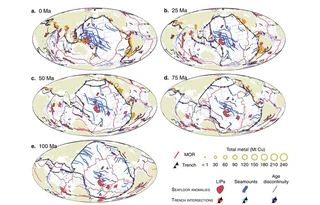 Spatial relationship between subducting seafloor anomalies and porphyry copper deposits along the American Cordillera.
Porphyry copper deposits are the world’s most important source of copper, and demand for copper is surging as the energy transition accelerates. Yet no significant new discoveries have been made in the last decade. Our new paper in International Geology Review identifies a key geological control that could help change that.
Not all subduction zones are equal
While porphyry deposits form above subduction zones, only some segments are productive. We find that all porphyry systems require continental crust thicker than 45 km, but that alone doesn’t guarantee a deposit. The critical additional ingredient is the character of the subducting ocean floor.
Seafloor anomalies are the key
The ocean floor is scarred by fracture zones, seamount chains, and remnants of large igneous provinces. These features carry higher degrees of hydrothermal alteration and serpentinization compared to normal seafloor. When subducted, they release enhanced fluxes of water and other volatiles that oxidise the sub-arc mantle — creating the conditions needed to concentrate copper in magmatic systems.
Using plate tectonic reconstructions spanning the last 100 million years and a machine learning classifier trained on known deposits, we find a strong correlation between the subduction of these seafloor anomalies and porphyry copper formation, particularly along the American Cordillera.
From EGU to AESC
I presented this work at EGU 2024 in Vienna and most recently at AESC 2026 in Melbourne, where the energy-transition relevance of this research resonated strongly with the Australian geoscience community.
Reference: Mather, B., Müller, R.D., Alfonso, C.P., Wright, N.M. & Seton, M. (2025). Subducting seafloor anomalies promote porphyry copper formation. International Geology Review. doi:10.1080/00206814.2025.2508791

I am an ARC Industry Research Fellow in the School of Geography, Earth and Atmospheric Sciences at The University of Melbourne. I am an expert in fusing Earth evolution models with data to understand how groundwater moves critical minerals through the landscape. Related research interests include the cycling of volatiles within the Earth, probabilistic thermal models of the lithosphere to unravel past tectonic and climatic events, and understanding the how enigmatic volcanoes form.
I am a vocal advocate for the integral role of geoscience in responding to challenges we face in transitioning to the carbon-neutral economy. As an expert in my field, I have been interviewed in national and international print media, TV, and radio on a wide variety of subjects including earthquakes, volcanoes, groundwater, and critical minerals.