How deep can carbon hide in the Pacific?

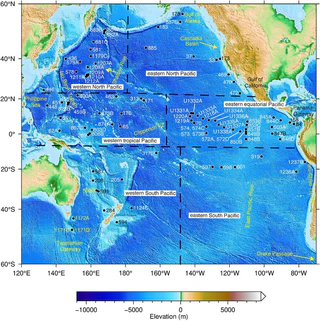 Regional carbonate compensation depth variability across the Pacific Ocean since the Oligocene.
The deep ocean floor acts as a massive carbon warehouse — tiny marine organisms sink to the seafloor after they die, locking away carbon in calcium carbonate shells. But this carbon is only preserved above a critical depth: the carbonate compensation depth (CCD), below which seawater dissolves carbonate faster than it accumulates.
In our new paper in Frontiers in Earth Science, we produce six new regional reconstructions of how the CCD has varied across the Pacific — the world’s deepest and largest ocean basin — over the past 30 million years.
What controls the CCD?
The reconstructions use carbonate accumulation rates plotted against paleo-water depth (corrected for dynamic topography and sea level changes) to estimate the CCD through time. The results reveal fluctuations of more than a kilometre in some regions, driven by:
- Antarctic ice sheet growth — The western Pacific CCD shows a distinct deepening around 24 Ma, interpreted as a delayed response to West Antarctic ice sheet expansion.
- Ocean gateway reorganisation — Changes in Pacific deep-water circulation patterns as gateways opened and closed.
- Climate perturbations — The well-known late Miocene “carbonate crash” and “biogenic bloom” appear in both western and eastern equatorial records, but with a ~1 million year lag in the west.
These regional patterns matter because global CCD averages can mask important spatial variability. Understanding where and when the ocean stores or releases carbon is essential for improving models of the long-term carbon cycle and its links to climate.
Reference: Dalvand, F., Dutkiewicz, A., Wright, N.M., Mather, B. & Müller, R.D. (2025). Regional carbonate compensation depth variability in the Pacific Ocean since the Oligocene. Frontiers in Earth Science. doi:10.3389/feart.2025.1605906

I am an ARC Industry Research Fellow in the School of Geography, Earth and Atmospheric Sciences at The University of Melbourne. I am an expert in fusing Earth evolution models with data to understand how groundwater moves critical minerals through the landscape. Related research interests include the cycling of volatiles within the Earth, probabilistic thermal models of the lithosphere to unravel past tectonic and climatic events, and understanding the how enigmatic volcanoes form.
I am a vocal advocate for the integral role of geoscience in responding to challenges we face in transitioning to the carbon-neutral economy. As an expert in my field, I have been interviewed in national and international print media, TV, and radio on a wide variety of subjects including earthquakes, volcanoes, groundwater, and critical minerals.