Mapping craton edges to find critical metals

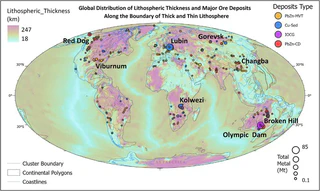 Clustered seismic velocity maps delineating craton boundaries and their spatial association with mineral deposits.
Where ancient, stable continental cores meet younger crust, faults and fractures create pathways for metal-rich fluids to travel upward and form mineral deposits. These craton boundaries are prime exploration targets — but precisely locating them has remained a challenge.
In our new paper in Geoscience Frontiers, we use the high-resolution REVEAL full-waveform seismic inversion model to extract shear and P-wave velocities at 150–200 km depth — the range that captures most cratonic lithosphere. Machine learning clustering applied to these velocity maps reveals that horizontal shear wave velocity (V_SH) is particularly effective at delineating craton edges.
Key results
- 85% of total metal content in iron oxide copper-gold (IOCG) and sediment-hosted Pb-Zn-Cu deposits lies within ~120 km of the mapped craton boundaries.
- By focusing on just 16% of Earth’s continental area — the zones near craton edges — explorers could potentially locate over 80% of known target deposits.
- The boundaries trace the edges of cratons, accreted passive margins, orogens, and thick volcanic arcs, characterised by high horizontal shear velocities of 4.58–4.68 km/s.
These results provide a powerful new screening tool for mineral exploration, helping to narrow the search for the critical metals needed for the energy transition.
Reference: Shirmard, H., Mather, B., Farahbakhsh, E., Czarnota, K. & Müller, R.D. (2025). Craton boundary detection from full-waveform tomography model reveals links to critical metal deposits. Geoscience Frontiers. doi:10.1016/j.gsf.2025.102176

I am an ARC Industry Research Fellow in the School of Geography, Earth and Atmospheric Sciences at The University of Melbourne. I am an expert in fusing Earth evolution models with data to understand how groundwater moves critical minerals through the landscape. Related research interests include the cycling of volatiles within the Earth, probabilistic thermal models of the lithosphere to unravel past tectonic and climatic events, and understanding the how enigmatic volcanoes form.
I am a vocal advocate for the integral role of geoscience in responding to challenges we face in transitioning to the carbon-neutral economy. As an expert in my field, I have been interviewed in national and international print media, TV, and radio on a wide variety of subjects including earthquakes, volcanoes, groundwater, and critical minerals.