Tracing ancient groundwater to discover copper

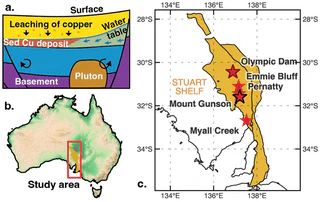 Sediment-hosted copper formation and the Stuart Shelf, South Australia.
The global transition to clean energy is driving unprecedented demand for copper. Renewable energy plants require 8–12 times more copper than fossil fuel plants, and electric vehicles need 3–4 times more copper than combustion vehicles. But existing reserves are being depleted faster than new ones are discovered.
My ARC Industry Research Fellowship, codesigned with BHP, tackles this challenge by modelling how ancient groundwater systems mobilised and concentrated copper within sedimentary basins.
Why groundwater matters for copper
Groundwater plays a fundamental role in redistributing copper within the subsurface and concentrating it into sediment-hosted copper deposits. Through long-term interaction with the water table, these “supergene” deposits form at shallower depths, require less energy to mine, and produce less waste than most conventional operations.
What we’re modelling
Using Underworld, a finite-element particle-in-cell framework, we solve for groundwater flow through a 3D geological model of the basin. The key steps are:
- Basin architecture — Assigning age-dependent porosity and permeability to detailed geological models and constraining palaeo-topography.
- Time-evolving flow — Running groundwater simulations forward through geological time to reconstruct flow rates, residence times, and pathways.
- Prospectivity mapping — Tracing fluid pathways from primary copper sources to identify likely zones of secondary enrichment across the basin.
What’s next
We are currently extending the modelling framework to incorporate reactive transport — tracking not just where fluids flow, but how they interact chemically with host rocks to precipitate copper minerals. This will sharpen the prospectivity maps and provide more actionable targets for exploration.
This project is a collaboration between the The University of Melbourne and BHP, funded through the Australian Research Council.

I am an ARC Industry Research Fellow in the School of Geography, Earth and Atmospheric Sciences at The University of Melbourne. I am an expert in fusing Earth evolution models with data to understand how groundwater moves critical minerals through the landscape. Related research interests include the cycling of volatiles within the Earth, probabilistic thermal models of the lithosphere to unravel past tectonic and climatic events, and understanding the how enigmatic volcanoes form.
I am a vocal advocate for the integral role of geoscience in responding to challenges we face in transitioning to the carbon-neutral economy. As an expert in my field, I have been interviewed in national and international print media, TV, and radio on a wide variety of subjects including earthquakes, volcanoes, groundwater, and critical minerals.