Go with the flow
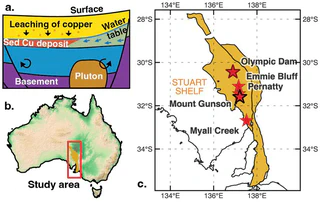 Sediment-hosted copper formation and the Stuart Shelf, South Australia
Tracing ancient groundwater pathways to discover copper
The global transition to clean energy is driving unprecedented demand for copper — renewable energy plants require 8–12 times more copper than fossil fuel-powered plants, and electric vehicles require 3–4 times more copper to produce than internal combustion vehicles. However, existing copper reserves are being depleted faster than new ones are discovered, making the search for new deposits a critical challenge.
Groundwater plays a fundamental role in redistributing copper within the subsurface and concentrating it into sediment-hosted copper deposits. Through long-term interaction with the water table, these “supergene” deposits require less energy to mine and produce less waste than most conventional mining operations.
This ARC Industry Research Fellowship, codesigned with BHP, combines expertise in continent-scale groundwater modelling with BHP’s expertise in copper exploration to create novel models of copper mobilisation within sedimentary basins.
Aims
The overarching aim is to unearth new copper deposits by modelling the evolution of fluid systems in sedimentary basins. Specifically:
- Constrain basin architecture — Assign age-dependent hydrologic properties (porosity and permeability) to detailed models of the Stuart Shelf and constrain its topography back through time.
- Time-evolving groundwater flow modelling — Assimilate these within a time-evolving model of groundwater flow to constrain fluid residence times, flow rates, and pathways in the basin required for primary copper deposit formation and secondary copper enrichment.
- Prospective zones of secondary copper enrichment — Interrogate fluid flow pathways from primary enrichment sources to identify likely zones of secondary copper enrichment which can be mapped across the entire basin.
Methods
The project uses Underworld, a finite-element particle-in-cell framework, to solve for groundwater flow through a 3D geological model of the Stuart Shelf, South Australia. Palaeo-topographic reconstructions are combined with age-coded sedimentary layers to reconstruct past landscapes and simulate how groundwater flow evolved over geological time. Long-term flow pathways from copper source rocks are traced to identify conduits for mobile copper transport and prospective zones of secondary enrichment.
Partners
This project is a collaboration between the EarthByte Group at The University of Sydney and BHP, funded through the Australian Research Council (ARC) Industry Research Fellowship scheme.