Variations and controls on lithospheric thermal regimes in Southeast Australia

Dec 1, 2017·
Dr. Ben Mather
Dr. Ben Mather
Sandra McLaren
Sandra McLaren
,
David Taylor
,
Sukanta Roy
Louis Moresi
Louis Moresi
· 1 min read
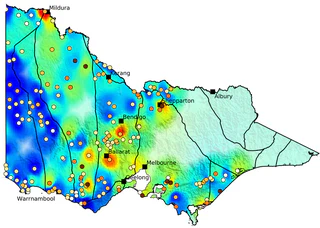
Surface heat flow variation in Victoria, Southeastern Australia
Abstract
The surface heat flow field in Australia has for many years been poorly constrained compared to continental regions elsewhere. 182 recent heat flow determinations and 66 new heat production measurements for Southeastern Australia significantly increase our understanding of local and regional lithospheric thermal regimes and allow for detailed thermal modelling. The new data give a mean surface heat flow for Victoria of 71+/-15mWm-2 which fits within the 61-77mWm-2 range reported for Phanerozoic-aged crust globally. These data reveal three new thermally and compositionally distinct heat flow sub-provinces within the previously defined Eastern Heat Flow Province: the Delamerian heat flow sub-province (average surface heat flow 60+/-9mWm-2); the Lachlan heat flow sub-province (average surface heat flow 74+/-13mWm-2); and the Newer Volcanics heat flow sub-province (average surface heat flow 72+/-16mWm-2) which includes extreme values that locally exceed 100mWm-2. Inversions of reduced heat flow and crustal differentiation find that the Delamerian sub-province has experienced significant crustal reworking compared to the Lachlan and Newer Volcanics sub-provinces. The latter has experienced volcanism within the last 8 Ma and the degree of variability observed in surface heat flow points (up to 8mWm-2 per kilometre laterally) cannot be replicated with steady-state thermal models through this sub-province. In the absence of a strong palaeoclimate signal, aquifer disturbances, or highly enriched granites, we suggest that this high variability arises from localised transient perturbations to the upper crust associated with recent intraplate volcanism. This is supported by a strong spatial correlation of high surface heat flow and known eruption points within the Newer Volcanics heat flow sub-province.
Type
Publication
Tectonophysics
publications

Plain Language Summary

Understanding how heat flows through the Earth’s crust is crucial for assessing geothermal energy potential, understanding tectonic processes, and predicting the mechanical behaviour of rocks at depth. This study presents 182 new heat flow measurements and 66 heat production measurements from Southeastern Australia — a region where thermal data had previously been sparse.

The results reveal three distinct thermal zones within the region: the cooler Delamerian zone, the warmer Lachlan zone, and the highly variable Newer Volcanics zone. In the Newer Volcanics zone, which experienced volcanic eruptions within the last 8 million years, heat flow can vary dramatically over just a few kilometres. This extreme variability cannot be explained by steady-state models and is likely caused by lingering thermal disturbances from recent volcanic activity.

These findings provide important baseline data for evaluating geothermal resources in southeastern Australia and highlight how recent volcanism can create localised hot spots in the crust that persist long after eruptions have ceased.

Dr. Ben Mather
Authors
ARC Industry Research Fellow

I am an ARC Industry Research Fellow in the School of Geography, Earth and Atmospheric Sciences at The University of Melbourne. I am an expert in fusing Earth evolution models with data to understand how groundwater moves critical minerals through the landscape. Related research interests include the cycling of volatiles within the Earth, probabilistic thermal models of the lithosphere to unravel past tectonic and climatic events, and understanding the how enigmatic volcanoes form.

I am a vocal advocate for the integral role of geoscience in responding to challenges we face in transitioning to the carbon-neutral economy. As an expert in my field, I have been interviewed in national and international print media, TV, and radio on a wide variety of subjects including earthquakes, volcanoes, groundwater, and critical minerals.

Sandra McLaren
Authors
Adjunct Associate Professor
Sandra McLaren researches Proterozoic tectonics, crustal thermal structure, and the origins of high heat-producing granites in Australia.
Authors
Senior Geologist
David Taylor has over 25 years of experience in regional geological mapping and led Victoria’s geothermal energy potential assessment.
Authors
Project Director
Sukanta Roy studies terrestrial heat flow and crustal thermal structure across the Indian shield, combining borehole measurements with geophysical modelling.
Louis Moresi
Authors
Professor of Computational Mathematics & Geophysics
Louis Moresi specialises in computational geodynamics, developing the Underworld software to model mantle convection, lithospheric deformation, and plate tectonics. He is a Fellow of the Australian Academy of Science and the American Geophysical Union.