Adjoint inversion of the thermal structure of Southeastern Australia


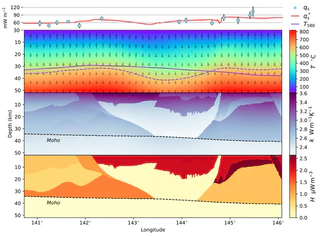 Model with the optimal tradeoff between Curie depth, heat flow data and a priori estimates of thermal conductivity and rates of heat production.
Modelling temperature in the Earth’s crust is accomplished by populating a geological model with thermal properties, such as thermal conductivity and rates of heat production, and solving a numerical model of thermal diffusion with assigned boundary conditions. The desired temperature solution is often the one that best matches our observations – e.g. temperature in a well – but strong assumptions are made of how thermal properties vary with depth, which result in simple first-order predictions of the temperature field.
Posing an inverse problem is a way to ascertain how much your observations tells you about a particular model. Finding better and better solutions usually require running model after model with slight changes in the input parameters to find a better fit to the observations. For instance, a lower rate of heat production in one layer of the Earth’s crust may result in a better match to an observation of heat flow coming out of the ground. This is fine if the number of unknowns is small, but when we start to increase the quantity of unknown parameters then it takes an exponentially long time to find the model that best reproduces our observations.
In this paper, we formulate a novel inversion method that uses the gradient to quickly find the optimal configuration of thermal properties that best match our observations. We publish improved estimates of the thermal state of the crust in Victoria using heat flow measurements and Curie depth in a joint inversion using 3D geological models, and numerical models of thermal diffusion. The outcome of this work is an estimation of basal heat flux, thermal properties, and the rate of heat production for various domains in the model together with uncertainty information.

I am an ARC Industry Research Fellow in the School of Geography, Earth and Atmospheric Sciences at The University of Melbourne. I am an expert in fusing Earth evolution models with data to understand how groundwater moves critical minerals through the landscape. Related research interests include the cycling of volatiles within the Earth, probabilistic thermal models of the lithosphere to unravel past tectonic and climatic events, and understanding the how enigmatic volcanoes form.
I am a vocal advocate for the integral role of geoscience in responding to challenges we face in transitioning to the carbon-neutral economy. As an expert in my field, I have been interviewed in national and international print media, TV, and radio on a wide variety of subjects including earthquakes, volcanoes, groundwater, and critical minerals.

