An Early Cretaceous subduction-modified mantle underneath the ultraslow spreading Gakkel Ridge, Arctic Ocean


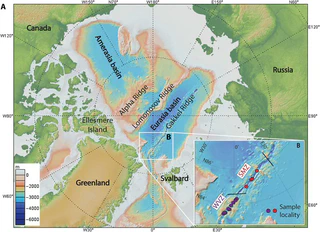
The Arctic Ocean is roughly 14,000 km away from Melbourne (Monash University, Australia), where most of the action for our recent publication ‘An Early Cretaceous subduction-modified mantle underneath the ultraslow spreading Gakkel Ridge, Arctic Ocean’ in Science Advances took place.
In this publication we investigated rocks from the Gakkel Ridge in the Arctic Ocean, an area where tectonic plates move apart and hot magma rises from the upper mantle (~80 km depth) to the ocean floor where magma solidifies as basaltic rock (figure below). Typically, the magma inherits some of the unique signature of the parental mantle, which allows to draw conclusion on the source and the formation processes.
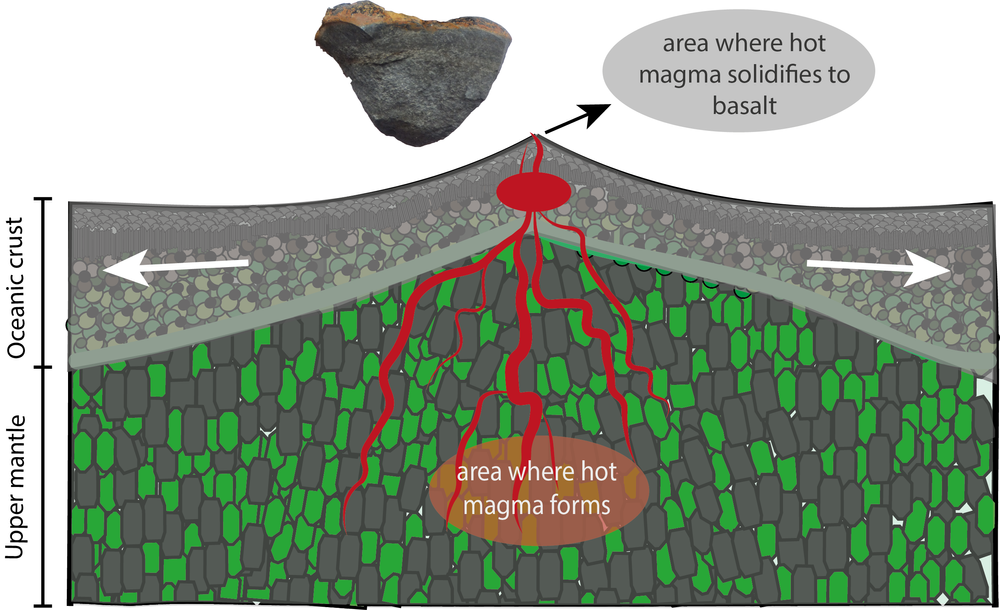
Cross-section of an mid-ocean ridge indicating the moving direction of the tectonic plates and showing the division between oceanic crust and upper mantle. At the top left is shown a typical basalt from oceanic ridges. The basalts for this study were dredged from the ocean floor by various research cruises to the Arctic Ocean more than 10 years ago.
To understand the mantle source, the surroundings in which hot magma forms, we crushed up the rock sample to fine powder and processed it further to a rock glass and dissolved ~100 mg of the powder into a liquid to extract the geochemical fingerprint using mass spectrometer at the Monash Isotopia facility. The results we obtained from these rocks were unusual for samples from an area where tectonic plates move apart. It rather suggested a geochemical signature typically found in areas where plates collide and island arc volcanoes are formed, e.g. along the ring-of-fire in the Western Pacific.
At present there is no evidence for island arc volcanism or plates colliding in our study area. Therefore, we delved back in time using a tool called ‘GPlates’. This tool allowed us to look at the plate reconstructions hundred of millions years ago in the greater Arctic region.
By using these plate reconstructions we identified that arc volcanism existed 130 million years ago in our sample area and concluded that this event must have left a geochemical imprint in the mantle that persists in the geochemical signatures of basaltic magmas formed in this area today. The figure below shows a possible explanation of such a process.
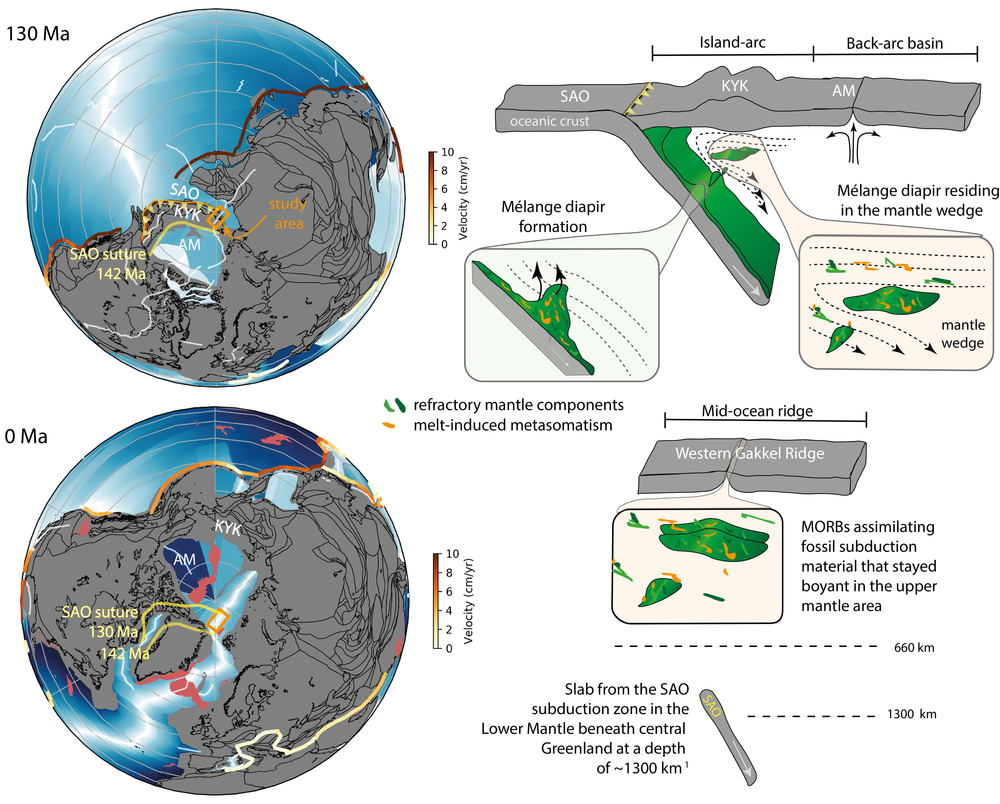
Paleogeography of the circum Arctic region. Upper panel: Active island-arc volcanism in the sample area leaving a geochemical imprint in the upper mantle at 130 Ma. Lower panel: After the island-arc volcanism ceased parts of the tectonic plate broke off and sank into deeper mantle areas (~1300 km), whereas the island-arc collided with parts in Siberia. Remnants of the island-arc volcanism 130 Myr's ago stayed buoyant in the upper mantle and became inherited in the basalts at present.
In this contribution we combined geochemical observations with plate reconstructions and used geodynamic principles to explain an unusual geochemical signature found in basalts from the Arctic ocean ridge. This project was a collaborative work across many geoscientific disciplines and universities (Monash University, University of Melbourne, University of Sydney and Woods Hole Oceanography Institute).


I am an ARC Industry Research Fellow in the School of Geography, Earth and Atmospheric Sciences at The University of Melbourne. I am an expert in fusing Earth evolution models with data to understand how groundwater moves critical minerals through the landscape. Related research interests include the cycling of volatiles within the Earth, probabilistic thermal models of the lithosphere to unravel past tectonic and climatic events, and understanding the how enigmatic volcanoes form.
I am a vocal advocate for the integral role of geoscience in responding to challenges we face in transitioning to the carbon-neutral economy. As an expert in my field, I have been interviewed in national and international print media, TV, and radio on a wide variety of subjects including earthquakes, volcanoes, groundwater, and critical minerals.


