Probabilistic surface heat flow estimates assimilating palaeoclimate history: new implications for the thermochemical structure of Ireland


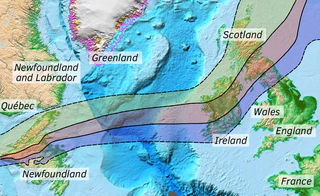 Plate reconstruction at 100Ma before the opening of the Atlantic Ocean
Plain Language Summary
Oscillations in the earth’s climate are often felt in the Earth’s subsurface. The depth these effects penetrate the crust depend on the duration of long-term climate change: if a region endured an ice age, how long the cold temperatures persisted will decide the how deep the thermal perturbation extends into the crust. The British Isles were capped in ice from 30 to 16 thousand years ago, which altered temperature gradients down to 5 km below the surface. Our reassessment of surface heat flow data in Ireland positively adjusts values by 15 mW/m2 if we account for this palaeoclimate effect, and significantly increases the likelihood of geothermal prospects.
Extending the heat flow data dataset to include the whole of the British Isles reveals a clear divide along an ancient suture that marks the boundary between two supercontinents. Laurentia and Avalonia were brought together as the Iapetus Ocean closed 420 million years ago. During and since their collision, heat-producing elements were more concentrated in the uppermost crust of Laurentia than Avalonia, which is visible at the surface by many hot granite bodies. We can also trace this same pattern to the other side of the Atlantic Ocean in Newfoundland. This has significant implications for the stability of continental lithosphere in Laurentia compared to Avalonia.

I am an ARC Industry Research Fellow in the School of Geography, Earth and Atmospheric Sciences at The University of Melbourne. I am an expert in fusing Earth evolution models with data to understand how groundwater moves critical minerals through the landscape. Related research interests include the cycling of volatiles within the Earth, probabilistic thermal models of the lithosphere to unravel past tectonic and climatic events, and understanding the how enigmatic volcanoes form.
I am a vocal advocate for the integral role of geoscience in responding to challenges we face in transitioning to the carbon-neutral economy. As an expert in my field, I have been interviewed in national and international print media, TV, and radio on a wide variety of subjects including earthquakes, volcanoes, groundwater, and critical minerals.
