Constraining the geotherm beneath the British Isles from Bayesian inversion of Curie depth: Integrated modelling of magnetic, geothermal and seismic data


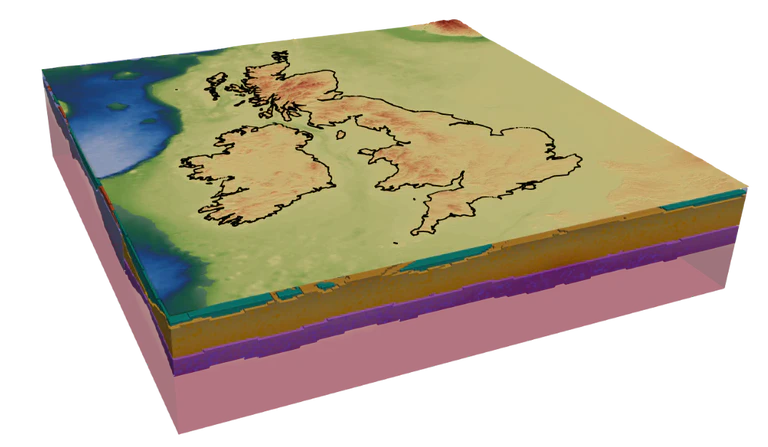 Model setup to simulate the temperature in the crust
Plain Language Summary
The Curie depth is the depth underground at which rocks become too hot for magnetic minerals to retain their magnetism — typically around 580°C. By analysing patterns in magnetic survey data, scientists can estimate this depth and use it to build a picture of underground temperatures across a wide area, even where direct measurements from boreholes are unavailable.
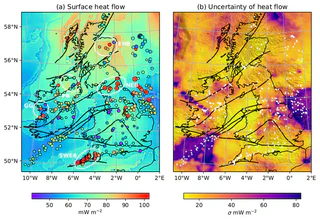
This study uses a statistical (Bayesian) approach to map the Curie depth and its uncertainty across the British Isles, then simulates the crustal temperature field using these estimates. The results show that the lithosphere thins from south to north across the Iapetus Suture — an ancient tectonic boundary — with shallower Curie depths and higher heat flow in northern Britain and Ireland. This pattern supports the hypothesis that a branch of the proto-Icelandic mantle plume thinned the lithosphere in this region during the Cenozoic.
The study also demonstrates that Curie depth estimates are most reliable where the crust is hottest (and the magnetic base is shallowest), and that combining Curie depth data with surface heat flow measurements significantly reduces uncertainty in estimated deep crustal temperatures — from unconstrained to within about ±73°C.

I am an ARC Industry Research Fellow in the School of Geography, Earth and Atmospheric Sciences at The University of Melbourne. I am an expert in fusing Earth evolution models with data to understand how groundwater moves critical minerals through the landscape. Related research interests include the cycling of volatiles within the Earth, probabilistic thermal models of the lithosphere to unravel past tectonic and climatic events, and understanding the how enigmatic volcanoes form.
I am a vocal advocate for the integral role of geoscience in responding to challenges we face in transitioning to the carbon-neutral economy. As an expert in my field, I have been interviewed in national and international print media, TV, and radio on a wide variety of subjects including earthquakes, volcanoes, groundwater, and critical minerals.
