Abstract
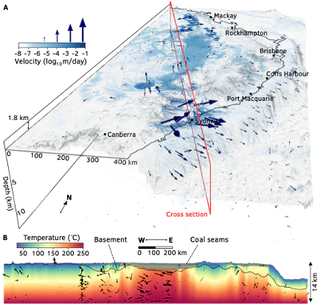
Numerical models of groundwater flow play a critical role for water management scenarios under climate extremes. Large‑scale models play a key role in determining long range flow pathways from continental interiors to the oceans, yet struggle to simulate the local flow patterns offered by small‑scale models. We have developed a highly scalable numerical framework to model continental groundwater flow which capture the intricate flow pathways between deep aquifers and the nearsurface. The coupled thermal‑hydraulic basin structure is inferred from hydraulic head measurements, recharge estimates from geochemical proxies, and borehole temperature data using a Bayesian framework. We use it to model the deep groundwater flow beneath the Sydney–Gunnedah–Bowen Basin, part of Australia’s largest aquifer system. Coastal aquifers have flow rates of up to 0.3 m/day, and a corresponding groundwater residence time of just 2,000 years. In contrast, our model predicts slow flow rates of 0.005 m/day for inland aquifers, resulting in a groundwater residence time of ∼ 400,000 years. Perturbing the model to account for a drop in borehole water levels since 2000, we find that lengthened inland flow pathways depart significantly from pre‑2000 streamlines as groundwater is drawn further from recharge zones in a drying climate. Our results illustrate that progressively increasing water extraction from inland aquifers may permanently alter long‑range flow pathways. Our open‑source modelling approach can be extended to any basin and may help inform policies on the sustainable management of groundwater.
Type
Publication
Scientific Reports
publicationsPlain Language Summary
Groundwater is one of Australia’s most vital resources, yet understanding how it flows through deep underground aquifer systems — especially over large distances and long timescales — remains a major challenge. This study develops a new computational framework to model groundwater flow at the continental scale, capturing both the broad flow patterns from inland to coast and the intricate local pathways through deep aquifers.
Applied to the Sydney–Gunnedah–Bowen Basin, one of Australia’s largest aquifer systems, the model reveals a stark contrast between coastal and inland groundwater. Coastal aquifers have relatively fast flow rates and water that is only about 2,000 years old, while inland aquifers move 60 times more slowly, with water that has been underground for roughly 400,000 years.
When the model is adjusted to account for the decline in borehole water levels observed since 2000, the results show that inland flow pathways shift significantly as groundwater is drawn further from recharge zones in a drying climate. This suggests that increasing water extraction from inland aquifers during drought could permanently redirect long-range underground flow paths — a finding with important implications for sustainable water management across Australia.