Evolution of Earth’s tectonic carbon conveyor belt
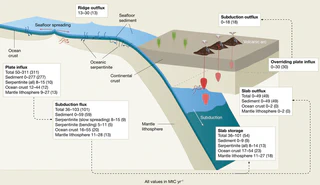 The Earth’s tectonic carbon conveyor belt shifts massive amounts of carbon between the deep Earth and the surface, from mid-ocean ridges to subduction zones, where oceanic plates carrying deep-sea sediments are recycled back into the Earth’s interior. The processes involved play a pivotal role in Earth’s climate and habitability.
Plain Language Summary
Hidden beneath the world’s oceans is a giant carbon conveyor belt, driven by the movement of tectonic plates. As new ocean floor forms at mid-ocean ridges, it absorbs carbon from seawater into its rocks and sediments. When this ocean floor is eventually pulled back into the Earth’s interior at subduction zones, some of that carbon is released back into the atmosphere through volcanic eruptions, while the rest is carried deeper into the mantle.
This study reconstructs how this tectonic carbon conveyor belt has operated over the past 250 million years. During the Cretaceous period, high-speed plate tectonics doubled volcanic CO₂ emissions, contributing to one of Earth’s warmest climates. The massive amount of carbon subducted during this time may even have triggered diamond formation beneath North America. As continental collisions later slowed seafloor spreading in the Cenozoic era, tectonic outgassing declined — but a new twist emerged: deep-sea carbonate sediments became the Earth’s largest carbon sink, and their recycling through subduction beneath volcanic arcs made arcs the dominant source of CO₂ emissions from about 20 million years ago.
The finding that solid Earth carbon emissions actually increased during the Cenozoic cooling period challenges previous assumptions and implies that continental weathering must have ramped up even more dramatically to draw down atmospheric CO₂ and cool the planet.
Explainer in The Conversation