Abstract
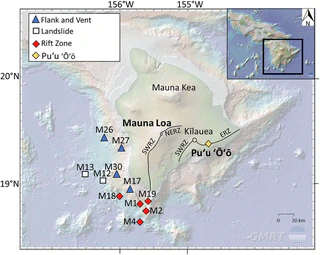
The Big Island of Hawai’i is currently the most active site of magmatic activity in the Hawaiian chain of volcanoes that are associated with a mantle plume in the Pacific Ocean. Mantle source variability and magmatic processes have both been proposed to significantly affect lava chemistry on the Big Island, which is most prominently illustrated in a radiogenic isotope dichotomy of the so-called ‘Kea’ and ‘Loa’ trends. Here, we present stable Fe isotopes (δ57Fe), complemented by radiogenic 176Hf/177Hf, in lavas from the Puʻu ʻŌʻō vent on the East Rift Zone of Kīlauea (Kea trend) and from the Southwest Rift Zone from Mauna Loa (Loa trend). In Hf isotopic space, lavas range from εHf = +8 to +13, with Puʻu ʻŌʻō samples aligning with published values of lavas from the ‘Kea-trend’ in Srsingle bondHf isotope space, whereas Mauna Loa basalts and picrites presented here coincide with values of the Loa-trend. The Puʻu ʻŌʻō lavas have average δ57Fe of +0.15 ‰ and an average of MgO ~ 7 wt%. Mauna Loa basalts and picrites show on average lighter δ57Fe of +0.06 ‰ but higher MgO ~ 16 wt%. Combined, in a global OIB comparison, the Hawaiian samples have among the lowest δ57Fe reported to date. Both Puʻu ʻŌʻō and Mauna Loa lavas lie on a trend of decreasing δ57Fe with increasing MgO that is ascribed to olivine fractionation and accumulation. Geochemical indices of partial melting (e.g., (Gd/Yb)PM, TiO2) do not align with Fe isotopic signatures, whether corrected for crystal fractionation or not, and can thus not explain the heavy Fe isotopic signatures observed here. Likewise, a lack of co-variations of radiogenic isotopes with Fe isotopes do not support source inheritance from enriched, crustal-like plume components as the dominant process to explain the Fe isotopic signatures. On a three‑iron isotope plot, it appears that kinetic in combination or in exchange with equilibrium fractionation of stable isotopes can account for Fe isotopes lighter than δ57Fe < +0.15 ‰. An inherently heavy Fe isotope signature (> 0.15 ‰) is required to explain some of the high values measured here for which no geochemical proxy can be identified. Assuming fast recharge into the plumbing systems feeding Puʻu ʻŌʻō and Mauna Loa lavas with no presumed homogenisation in subsurface magma chambers, we surmise that the Hawaiian samples are reflecting lavas that experienced a combination of kinetic and equilibrium processes, which ultimately lead to a seemingly random distribution of Fe isotopes. The exposure to different magmatic processes, e.g., re-charging events, and the missing covariation between MgO vs δ57Fe argue for an open magma chamber underneath Puʻu ʻŌʻō and Mauna Loa, masking processes that influence Fe isotopes, i.e., source inheritance or melting degree. From our new stable Fe isotope data, we show that lavas, which travel through a plumbing system, can undergo multiple fractionation processes.
Type
Publication
Chemical Geology
publicationsPlain Language Summary
The Big Island of Hawai’i sits above a mantle plume — a column of hot rock rising from deep within the Earth — and is home to some of the world’s most active volcanoes, including Kīlauea and Mauna Loa. The chemical composition of lavas erupted from these volcanoes provides clues about the processes happening deep underground, but untangling the different influences on lava chemistry is notoriously difficult.
This study measures the ratios of iron isotopes in lavas from Kīlauea’s Pu’u ‘Ō’ō vent and Mauna Loa’s Southwest Rift Zone. Iron isotope ratios are sensitive to how magma crystallises, how it interacts with surrounding rocks, and the composition of its deep mantle source. The Hawaiian lavas turn out to have some of the lightest iron isotope signatures ever reported for ocean island basalts, with a clear trend linked to the crystallisation and accumulation of the mineral olivine.
However, the data also show that the iron isotope signatures are not simply inherited from the mantle source or controlled by a single process. Instead, multiple overlapping processes — including kinetic effects during rapid magma movement and equilibrium crystallisation — scramble the isotopic signal. This supports the picture of open magma chambers beneath these volcanoes, where frequent recharge of fresh magma prevents any single process from leaving a clean fingerprint in the lava chemistry.