Iron isotope systematics during igneous differentiation in lavas from Kīlauea and Mauna Loa, Hawai'i


Plain Language Summary
The Big Island of Hawai’i sits above a mantle plume — a column of hot rock rising from deep within the Earth — and is home to some of the world’s most active volcanoes, including Kīlauea and Mauna Loa. The chemical composition of lavas erupted from these volcanoes provides clues about the processes happening deep underground, but untangling the different influences on lava chemistry is notoriously difficult.
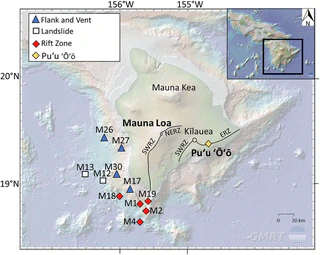
This study measures the ratios of iron isotopes in lavas from Kīlauea’s Pu’u ‘Ō’ō vent and Mauna Loa’s Southwest Rift Zone. Iron isotope ratios are sensitive to how magma crystallises, how it interacts with surrounding rocks, and the composition of its deep mantle source. The Hawaiian lavas turn out to have some of the lightest iron isotope signatures ever reported for ocean island basalts, with a clear trend linked to the crystallisation and accumulation of the mineral olivine.
However, the data also show that the iron isotope signatures are not simply inherited from the mantle source or controlled by a single process. Instead, multiple overlapping processes — including kinetic effects during rapid magma movement and equilibrium crystallisation — scramble the isotopic signal. This supports the picture of open magma chambers beneath these volcanoes, where frequent recharge of fresh magma prevents any single process from leaving a clean fingerprint in the lava chemistry.


I am an ARC Industry Research Fellow in the School of Geography, Earth and Atmospheric Sciences at The University of Melbourne. I am an expert in fusing Earth evolution models with data to understand how groundwater moves critical minerals through the landscape. Related research interests include the cycling of volatiles within the Earth, probabilistic thermal models of the lithosphere to unravel past tectonic and climatic events, and understanding the how enigmatic volcanoes form.
I am a vocal advocate for the integral role of geoscience in responding to challenges we face in transitioning to the carbon-neutral economy. As an expert in my field, I have been interviewed in national and international print media, TV, and radio on a wide variety of subjects including earthquakes, volcanoes, groundwater, and critical minerals.