Abstract
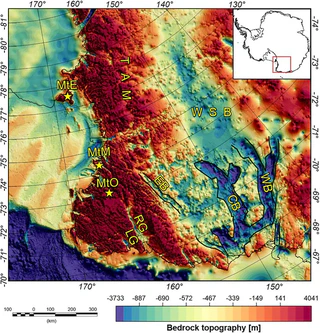
The Transantarctic Mountains (TAMs) separate the warmer lithosphere of the Cretaceous-Tertiary West Antarctic rift system and the colder and older provinces of East Antarctica. Low velocity zones beneath the TAM imaged in recent seismological studies have been interpreted as warm low-density mantle material, suggesting a strong contribution of thermal support to the uplift of the TAM. We present new Curie Point Depth (CPD) and geothermal heat flow (GHF) maps of the northern TAM and adjacent Wilkes Subglacial Basin (WSB) based exclusively on high resolution magnetic airborne measurements. We find shallow CPD and high GHF beneath the northern TAM, reinforcing the hypothesis of thermal support of the topography of the mountain range. Additionally, this study demonstrates, that limiting spectral analysis to areas with a high density of aeromagnetic measurements increases the resolution of CPD estimates revealing localized shallow CPD and associated high heat flow in the Central Basin of the WSB and the Rennick Graben (RG). Across the study area the CPD ranges from 15 to 35 km and the GHF values range from 30 to 110 mW/m2. The recovered CPD range is compatible with recent Moho depth estimates, as the CPD predominantly lies within the crust, rather than in the magnetite-poor mantle. GHF estimates, based on the CPD estimates, show a good agreement to sparse in situ GHF measurements and the location of active volcanoes. Comparison to existing continent-wide GHF estimates shows strong differences from magnetically-derived heat flow estimates, while seismologically-derived heat flow estimates show the best agreement to our results.
Type
Publication
Journal of Geophysical Research: Solid Earth
publicationsPlain Language Summary
The Transantarctic Mountains are one of the longest mountain ranges on Earth, separating the geologically younger West Antarctica from the ancient East Antarctic craton. Scientists have long debated what holds these mountains up — whether it is the buoyancy of thick crustal roots or heat rising from deeper in the Earth. This study uses magnetic data collected from aircraft to estimate the Curie depth — the depth at which rocks become too hot for magnetic minerals to retain their magnetism — as a proxy for underground temperatures.
The results reveal unusually shallow Curie depths and high heat flow beneath the northern Transantarctic Mountains, supporting the idea that warm mantle material is helping to prop up the mountain range from below. The study also finds pockets of elevated heat flow in the adjacent Wilkes Subglacial Basin and the Rennick Graben, regions hidden beneath the Antarctic ice sheet.
These heat flow estimates are important for understanding ice sheet dynamics, since basal heat flow influences whether the bottom of the ice sheet melts and how ice flows. The findings provide new constraints on the thermal state of East Antarctica, which remains one of the least explored continents on Earth.