Abstract
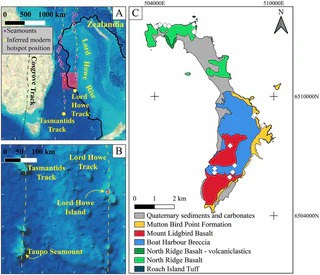
Thermochemical convective instabilities in the mantle, often referred to as mantle plumes, cause mantle melting that give rise to ocean island basalts (OIB) in intraplate settings. The array of radiogenic isotope signatures in global intraplate OIB indicate that although plumes are individual entities, they share enriched components that resemble various parts of subducted crust and a hypothetical mantle matrix termed ‘focal zone’ (FOZO). Each plume is expected to rise with an individual buoyancy flux, thereby producing variable volumes of melting with some OIB forming subaerial islands, whereas others produce submarine volcanoes. Here, we report the first radiogenic isotope data (Sr, Nd, Pb and Hf) for lavas of Lord Howe Island (LHI) in the Tasman Sea, the most prominent subaerial expression of the hypothesised Lord Howe mantle plume. Major element data are consistent with a moderate degree of partial melting, and heavy rare earth element depletion indicates melting occurred in the presence of garnet, consistent with other global plume lavas. Radiogenic SrNd isotopic data are similar to those defining the relatively primitive FOZO component with no clear enriched mantle affinity. The nearby Tasmantid Seamounts are also sourced from a mantle plume, and have similar SrNd character. However, combined Pb ratios of LHI lavas are inconsistent with a FOZO-type source. Instead, Pb isotopes overlap with typical enriched mantle 1 (EM1) lavas, trending slightly higher than the Northern Hemisphere Reference Line. Hafnium isotopes follow trends observed in lavas of the archetypal EM1 Pitcairn-Gambier islands. The combined element-isotope data indicate that LHI forms the most recent expression of a mantle plume track in the Tasman Sea.
Type
Publication
Chemical Geology
publicationsPlain Language Summary
Lord Howe Island, a UNESCO World Heritage site in the Tasman Sea between Australia and New Zealand, is the tip of an ancient volcano that formed when hot rock from deep within the Earth — a mantle plume — melted and erupted at the surface. Until this study, nobody had analysed the detailed isotopic composition of Lord Howe Island’s volcanic rocks, leaving its deep origins a mystery.
By measuring the ratios of strontium, neodymium, lead, and hafnium isotopes in the island’s lavas, this study reveals that Lord Howe Island shares a deep mantle source with the nearby Tasmantid Seamount chain — an underwater chain of volcanoes running parallel to it. The isotopic signatures suggest that both volcanic chains are fed by fingers of hot rock rising from the same large mantle plume beneath the Tasman Sea, with an ancient piece of recycled oceanic crust embedded in their source.
This discovery supports the idea that ’twin’ volcanic chains can form from a single large plume that splits into multiple fingers as it rises toward the surface. The only reason Lord Howe Island formed above sea level while the Tasmantid volcanoes remain submerged is that Lord Howe sits on a ribbon of continental crust, giving it the extra elevation needed to break the ocean surface.