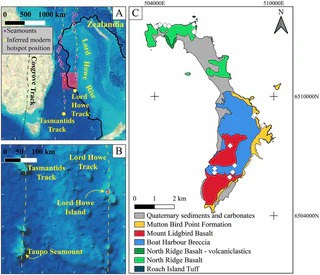
The isotopic origin of Lord Howe Island reveals secondary mantle plume twinning in the Tasman Sea

Apr 1, 2023·
Angus Rogers
Angus Rogers
,
Michaela Flanigan
Oliver Nebel
Oliver Nebel
Yona Nebel-Jacobsen
Yona Nebel-Jacobsen
,
Xueying Wang
Richard J. Arculus
Richard J. Arculus
,
Laura Miller
,
Ian Smith
Dr. Ben Mather
Dr. Ben Mather
Mark Kendrick
Mark Kendrick
,
Hugh St. C. O'Neill
· 2 min read
Abstract
Thermochemical convective instabilities in the mantle, often referred to as mantle plumes, cause mantle melting that give rise to ocean island basalts (OIB) in intraplate settings. The array of radiogenic isotope signatures in global intraplate OIB indicate that although plumes are individual entities, they share enriched components that resemble various parts of subducted crust and a hypothetical mantle matrix termed ‘focal zone’ (FOZO). Each plume is expected to rise with an individual buoyancy flux, thereby producing variable volumes of melting with some OIB forming subaerial islands, whereas others produce submarine volcanoes. Here, we report the first radiogenic isotope data (Sr, Nd, Pb and Hf) for lavas of Lord Howe Island (LHI) in the Tasman Sea, the most prominent subaerial expression of the hypothesised Lord Howe mantle plume. Major element data are consistent with a moderate degree of partial melting, and heavy rare earth element depletion indicates melting occurred in the presence of garnet, consistent with other global plume lavas. Radiogenic SrNd isotopic data are similar to those defining the relatively primitive FOZO component with no clear enriched mantle affinity. The nearby Tasmantid Seamounts are also sourced from a mantle plume, and have similar SrNd character. However, combined Pb ratios of LHI lavas are inconsistent with a FOZO-type source. Instead, Pb isotopes overlap with typical enriched mantle 1 (EM1) lavas, trending slightly higher than the Northern Hemisphere Reference Line. Hafnium isotopes follow trends observed in lavas of the archetypal EM1 Pitcairn-Gambier islands. The combined element-isotope data indicate that LHI forms the most recent expression of a mantle plume track in the Tasman Sea.
Type
Publication
Chemical Geology
publications

Plain Language Summary

Lord Howe Island, a UNESCO World Heritage site in the Tasman Sea between Australia and New Zealand, is the tip of an ancient volcano that formed when hot rock from deep within the Earth — a mantle plume — melted and erupted at the surface. Until this study, nobody had analysed the detailed isotopic composition of Lord Howe Island’s volcanic rocks, leaving its deep origins a mystery.

By measuring the ratios of strontium, neodymium, lead, and hafnium isotopes in the island’s lavas, this study reveals that Lord Howe Island shares a deep mantle source with the nearby Tasmantid Seamount chain — an underwater chain of volcanoes running parallel to it. The isotopic signatures suggest that both volcanic chains are fed by fingers of hot rock rising from the same large mantle plume beneath the Tasman Sea, with an ancient piece of recycled oceanic crust embedded in their source.

This discovery supports the idea that ’twin’ volcanic chains can form from a single large plume that splits into multiple fingers as it rises toward the surface. The only reason Lord Howe Island formed above sea level while the Tasmantid volcanoes remain submerged is that Lord Howe sits on a ribbon of continental crust, giving it the extra elevation needed to break the ocean surface.

Angus Rogers
Authors
Postdoctoral Researcher
Angus Rogers researches the chemical and geodynamic complexities of oceanic volcanism in the southwest Pacific and eastern Australia, with expertise in isotope geochemistry, U-Th-Pb dating, and ocean island basalts.
Authors
Researcher
Michaela Flanigan uses radiogenic isotope systems to investigate the geochemical origins of oceanic volcanism in the southwest Pacific.
Oliver Nebel
Authors
Professor of Geochemistry
Oliver Nebel is a high-temperature geochemist who uses rock and mineral chemistry, and stable and radiogenic isotope compositions, to study mantle composition, ocean floor volcanic activity, and crust-mantle evolution. He directs the Monash Isotopia Laboratory.
Yona Nebel-Jacobsen
Authors
Senior Research Manager, Isotopia Lab
Yona Nebel-Jacobsen is a geologist and isotope geochemist who manages the Monash Isotopia clean laboratory, specialising in chromatographic purification and high-precision isotope analyses. Her research interests include Early Earth processes and high-temperature geochemistry.
Authors
Academic Specialist (ICP-MS)
Xueying Wang is an analytical geochemist with expertise in isotopic and elemental analysis using ICP-MS, contributing to research on tin isotope systematics in subduction zones.
Richard J. Arculus
Authors
Emeritus Professor
Richard Arculus’s research focuses on the geochemistry and magmatic evolution of island arc systems in the Pacific Ring of Fire.
Authors
Research Fellow
Laura Miller’s research focuses on high-temperature geochemistry and experimental petrology, including the behaviour of trace elements in silicate melts.
Authors
Emeritus Associate Professor
Ian Smith uses geochemistry to understand volcanic systems, with a focus on the Auckland Volcanic Field and Late Cenozoic basaltic volcanism in the southwest Pacific.
Dr. Ben Mather
Authors
ARC Industry Research Fellow

I am an ARC Industry Research Fellow in the School of Geography, Earth and Atmospheric Sciences at The University of Melbourne. I am an expert in fusing Earth evolution models with data to understand how groundwater moves critical minerals through the landscape. Related research interests include the cycling of volatiles within the Earth, probabilistic thermal models of the lithosphere to unravel past tectonic and climatic events, and understanding the how enigmatic volcanoes form.

I am a vocal advocate for the integral role of geoscience in responding to challenges we face in transitioning to the carbon-neutral economy. As an expert in my field, I have been interviewed in national and international print media, TV, and radio on a wide variety of subjects including earthquakes, volcanoes, groundwater, and critical minerals.

Mark Kendrick
Authors
Associate Professor of Geochemistry
Mark Kendrick uses noble gas isotopes and halogens to investigate the role of fluids and volatiles in geological processes from the Earth’s surface to the deep mantle, with interests in hydrothermal alteration and subduction zone processes.
Authors
Emeritus Professor
Hugh O’Neill combines experimental petrology and thermodynamics to investigate the origin and chemical evolution of Earth and terrestrial planets.