Global Hydrogen Production During High-Pressure Serpentinization of Subducting Slabs

Oct 1, 2023·
Andrew S. Merdith
Andrew S. Merdith
,
Isabelle Daniel
Dimitri Sverjensky
Dimitri Sverjensky
Muriel Andreani
Muriel Andreani
Dr. Ben Mather
Dr. Ben Mather
Simon Williams
Simon Williams
Alberto Vitale Brovarone
· 1 min read
Abstract
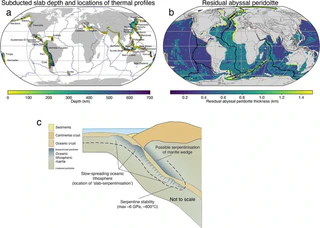
Serpentinization is among the most important, and ubiquitous, geological processes in crustal-upper mantle conditions (<6 GPa, <600°C), altering the rheology of rocks and producing H2 that can sustain life. While observations are available to quantify serpentinization in terrestrial and mid-ocean ridge environments, measurements within subduction zone environments are far more sparse. To overcome this difficulty, we design a methodology to quantify and offer a first-order estimate of the magnitude of ‘slab-serpentinization’ that has occurred over the last 5 Ma within the world’s subduction zones by coupling four discrete tectonic and geophysical datasets — raster grids of relic abyssal peridotite within ocean basins, slab geometry, thermal profiles and a plate-tectonic model. Averaged per year, our results suggest that 4.2–24 × 10⁷ kg of H2 per annum could be generated from slab-serpentinization within a subduction zone. Our estimate is 1–2 orders of magnitude lower than what is thought to be produced at mid-ocean ridges, and of a similar magnitude to what could occur when including serpentinization at trench flexure and possible mantle wedge serpentinization.
Type
Publication
Geochemistry, Geophysics, Geosystems
publications

Plain Language Summary

When oceanic tectonic plates are pushed beneath other plates at subduction zones, the rocks undergo dramatic chemical changes as they encounter high pressures and temperatures. One of the most important of these reactions is serpentinization — a process where water reacts with iron-rich mantle rocks to produce hydrogen gas (H₂). This hydrogen can fuel microbial life in some of Earth’s most extreme environments, making serpentinization a key process for understanding the limits of life on our planet and potentially on other worlds.

This study develops a new method to estimate how much hydrogen is produced by serpentinization within subducting slabs globally. By combining information about the type of rock being subducted, the geometry and temperature of subduction zones, and a plate tectonic model, the researchers calculate that subduction-zone serpentinization generates between 42 and 240 million kilograms of hydrogen per year.

While this is one to two orders of magnitude less than the hydrogen produced at mid-ocean ridges, it represents a significant and previously unquantified source of this vital gas. The amount of hydrogen produced is most strongly linked to the spreading history of the ocean basin — highlighting how the tectonic history of a slab before it is subducted shapes the chemistry of the deep Earth.

Andrew S. Merdith
Authors
ARC DECRA Fellow
Andrew Merdith is a computational Earth scientist whose research focuses on Neoproterozoic plate tectonic reconstructions and the supercontinent cycle. He co-developed the first full tectonic plate reconstruction of the last billion years.
Authors
Professor of Earth Sciences
Isabelle Daniel investigates minerals, fluids, and microorganisms under extreme pressure conditions, with major contributions to understanding deep carbon cycling and serpentinization.
Dimitri Sverjensky
Authors
Professor of Earth and Planetary Sciences
Dimitri Sverjensky investigates the role of water in deep Earth processes, including the origins of fluids in diamonds and transport of volatiles in subduction zones.
Muriel Andreani
Authors
Associate Professor
Muriel Andreani investigates serpentinization of ultramafic rocks and its implications for hydrogen production and abiotic organic synthesis in hydrothermal environments.
Dr. Ben Mather
Authors
ARC Industry Research Fellow

I am an ARC Industry Research Fellow in the School of Geography, Earth and Atmospheric Sciences at The University of Melbourne. I am an expert in fusing Earth evolution models with data to understand how groundwater moves critical minerals through the landscape. Related research interests include the cycling of volatiles within the Earth, probabilistic thermal models of the lithosphere to unravel past tectonic and climatic events, and understanding the how enigmatic volcanoes form.

I am a vocal advocate for the integral role of geoscience in responding to challenges we face in transitioning to the carbon-neutral economy. As an expert in my field, I have been interviewed in national and international print media, TV, and radio on a wide variety of subjects including earthquakes, volcanoes, groundwater, and critical minerals.

Simon Williams
Authors
ARC Future Fellow
Simon Williams is a geophysicist specialising in gravity and magnetic data analysis to define sedimentary basins and understand plate tectonics. Previously a long-standing member of the EarthByte Group, he now leads marine geoscience research at IMAS.
Alberto Vitale Brovarone
Authors
Professor of Petrology and Petrography
Alberto Vitale Brovarone is a metamorphic petrologist who studies high-pressure mineral reactions, deep carbon cycling, and abiotic hydrocarbon production in subduction zones.