Kimberlite eruptions driven by slab flux and subduction angle
Plain Language Summary
Kimberlite eruptions are among the most explosive volcanic events in Earth’s history and are the primary way diamonds are brought from deep within the mantle — over 150 kilometres below the surface — up to where we can find them. Despite their importance, scientists have struggled to explain what triggers these eruptions, which often occur far from the edges of tectonic plates where most volcanic activity is concentrated.
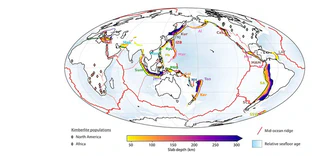
This study uses machine learning to identify the key tectonic factors that control kimberlite eruptions across the globe. The results show that the volume of oceanic plate being pushed down into the Earth’s interior at subduction zones — a quantity called slab flux — is strongly correlated with when and where kimberlites erupt. When more oceanic plate is being subducted, kimberlite eruptions become more frequent, even in the deep interiors of continents thousands of kilometres from the nearest subduction zone.
The findings suggest that the recycling of oceanic plates into the deep Earth can disturb the mantle far from plate boundaries, triggering the rapid ascent of kimberlite magmas through thick continental crust. This provides a new framework for understanding how deep Earth processes connect to surface volcanism and diamond formation.