Flexural isostatic response of continental-scale deltas to climatically driven sea level changes
Plain Language Summary
Large river deltas, such as the Mississippi or the Ganges, are among the most densely populated and economically important landscapes on Earth. These massive deposits of sediment are shaped not only by rivers carrying material from the continental interior to the coast, but also by the way the Earth’s crust flexes under the changing weight of water and sediment — a process called flexural isostasy.
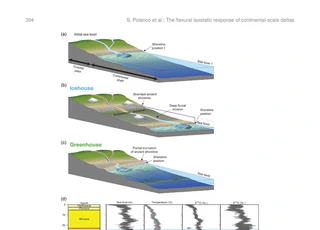
This study uses computer simulations to explore how deltas on passive continental margins respond when sea level rises and falls due to climate cycles. When sea level drops, sediment is deposited further offshore and the weight on the crust shifts; when sea level rises, the pattern reverses. The results show that the crust responds in both directions over timescales of 100,000 to 1,000,000 years, and this flexing is closely tied to the speed and magnitude of sea level change.
Importantly, the study finds that isostatic adjustments influence where river mouths end up and how sediment accumulates across the continental shelf. This means that the shape and internal structure of large deltas are not just products of river processes and sea level change alone — the bending of the Earth’s crust in response to shifting loads is a crucial factor that needs to be included in models of delta evolution.