Duration of Sturtian 'Snowball Earth' glaciation linked to exceptionally low mid-ocean ridge outgassing
Plain Language Summary
Around 717 million years ago, the Earth entered the most extreme ice age in its history — the Sturtian “Snowball Earth” glaciation — when ice sheets may have extended all the way to the equator. This global deep-freeze lasted an extraordinary 57 million years, but what triggered it and kept the planet frozen for so long has remained a major scientific puzzle.
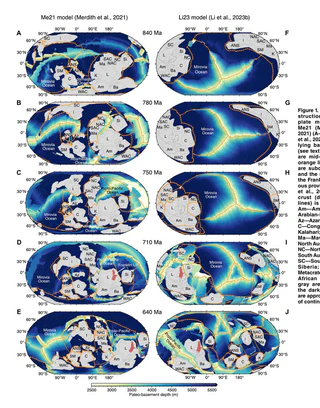
This study uses two independent models of how tectonic plates moved during this ancient period to test whether plate tectonics could explain the glaciation. The researchers find that volcanic CO₂ emissions from continental arcs stayed roughly constant and are unlikely to be the cause. Instead, one of the tectonic models reveals that mid-ocean ridge outgassing — the CO₂ released where new ocean floor is created — dropped to extremely low levels around the time of the glaciation, potentially starving the atmosphere of the greenhouse gas needed to keep the planet warm.
The combination of very low mid-ocean ridge CO₂ emissions and the weathering of a massive volcanic province (the Franklin large igneous province) may have tipped the planet into a snowball state. Once frozen, reduced silicate weathering meant that CO₂ slowly accumulated in the atmosphere from ongoing volcanism until, after 57 million years, greenhouse warming finally melted the ice.