Duration of Sturtian 'Snowball Earth' glaciation linked to exceptionally low mid-ocean ridge outgassing

Apr 1, 2024·
Adriana Dutkiewicz
Adriana Dutkiewicz
Andrew S. Merdith
Andrew S. Merdith
Alan S. Collins
Alan S. Collins
Dr. Ben Mather
Dr. Ben Mather
Lauren Ilano
Lauren Ilano
Sabin Zahirovic
Sabin Zahirovic
R. Dietmar Müller
R. Dietmar Müller
· 2 min read
Abstract
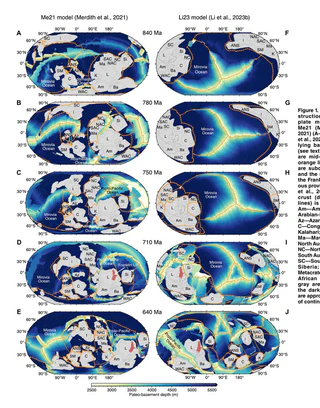
The Sturtian ‘Snowball Earth’ glaciation (ca. 717–661 Ma) is regarded as the most extreme interval of icehouse climate in Earth’s history. The exact trigger and sustention mechanisms for this long-lived global glaciation remain obscure. The most widely debated causes are silicate weathering of the ca. 718 Ma Franklin large igneous province (LIP) and changes in the length and degassing of continental arcs. A new generation of two independent Neoproterozoic full-plate tectonic models now allows us to quantify the role of tectonics in initiating and sustaining the Sturtian glaciation. We find that continental arc length remains relatively constant from 850 Ma until the end of the glaciation in both models and is unlikely to play a role. The two plate motion models diverge in their predictions of the timing and progression of Rodinia break-up, ocean-basin age, ocean-basement depth, sea-level evolution, and mid-ocean ridge (MOR) carbon outflux. One model predicts MOR outflux and ocean basin volume-driven sea level lower than during the Late Cenozoic glaciation, while the other predicts outgassing and sea level exceeding those of the Late Cretaceous hothouse climate.
Type
Publication
Geology
publications

Plain Language Summary

Around 717 million years ago, the Earth entered the most extreme ice age in its history — the Sturtian “Snowball Earth” glaciation — when ice sheets may have extended all the way to the equator. This global deep-freeze lasted an extraordinary 57 million years, but what triggered it and kept the planet frozen for so long has remained a major scientific puzzle.

This study uses two independent models of how tectonic plates moved during this ancient period to test whether plate tectonics could explain the glaciation. The researchers find that volcanic CO₂ emissions from continental arcs stayed roughly constant and are unlikely to be the cause. Instead, one of the tectonic models reveals that mid-ocean ridge outgassing — the CO₂ released where new ocean floor is created — dropped to extremely low levels around the time of the glaciation, potentially starving the atmosphere of the greenhouse gas needed to keep the planet warm.

The combination of very low mid-ocean ridge CO₂ emissions and the weathering of a massive volcanic province (the Franklin large igneous province) may have tipped the planet into a snowball state. Once frozen, reduced silicate weathering meant that CO₂ slowly accumulated in the atmosphere from ongoing volcanism until, after 57 million years, greenhouse warming finally melted the ice.

Adriana Dutkiewicz
Authors
Associate Professor
Adriana Dutkiewicz is a sedimentologist in the EarthByte Group who uses scientific ocean drilling data to understand deep-sea circulation and carbon reservoirs over geological time. She is the first woman to receive the Australian Academy of Science’s Mawson Medal.
Andrew S. Merdith
Authors
ARC DECRA Fellow
Andrew Merdith is a computational Earth scientist whose research focuses on Neoproterozoic plate tectonic reconstructions and the supercontinent cycle. He co-developed the first full tectonic plate reconstruction of the last billion years.
Alan S. Collins
Authors
Professor of Earth Sciences
Alan Collins is a tectonic geologist who investigates how deep Earth evolution has governed surface systems, using geochronology and structural geology to unravel the assembly of Gondwana.
Dr. Ben Mather
Authors
ARC Industry Research Fellow

I am an ARC Industry Research Fellow in the School of Geography, Earth and Atmospheric Sciences at The University of Melbourne. I am an expert in fusing Earth evolution models with data to understand how groundwater moves critical minerals through the landscape. Related research interests include the cycling of volatiles within the Earth, probabilistic thermal models of the lithosphere to unravel past tectonic and climatic events, and understanding the how enigmatic volcanoes form.

I am a vocal advocate for the integral role of geoscience in responding to challenges we face in transitioning to the carbon-neutral economy. As an expert in my field, I have been interviewed in national and international print media, TV, and radio on a wide variety of subjects including earthquakes, volcanoes, groundwater, and critical minerals.

Lauren Ilano
Authors
Research Assistant, EarthByte Group
Lauren Ilano works on pythonic workflows using pyGPlates for reconstructing geological features and their kinematics over geological time. She is a co-contributor to the GPlately software package.
Sabin Zahirovic
Authors
Lecturer and Robinson Fellow
Sabin Zahirovic is an Earth scientist focused on the deep-time evolution of our planet, specialising in global plate tectonic reconstructions, geodynamics, paleogeography, and the links between plate tectonics and the deep carbon cycle.
R. Dietmar Müller
Authors
Professor of Geophysics
Dietmar Müller leads the EarthByte Group and is a Fellow of the Australian Academy of Science. His research focuses on plate tectonics, geodynamics, and the development of the GPlates software for producing open-access models of Earth’s dynamic history.