Spreading ridge migration enabled by plume-ridge de-anchoring
Plain Language Summary
Mid-ocean ridges — the vast underwater mountain chains where new ocean floor is created — are not fixed in place. Over millions of years, they can migrate thousands of kilometres across the ocean basins. Scientists have traditionally explained this movement by the pulling forces of subducting plates on either side of a ridge, but this study reveals that hot mantle plumes rising from deep within the Earth also play a critical role.
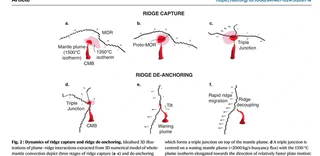
Using computer simulations of mantle convection, the researchers show that powerful mantle plumes can effectively capture and anchor a spreading ridge in place, preventing it from migrating. However, if the plume weakens over time, it releases its grip on the ridge — a process the authors call “de-anchoring” — allowing the ridge to suddenly migrate rapidly, especially when combined with uneven pulling forces from subduction zones on either side.
The study applies this mechanism to explain the rapid migration of the Southeast Indian Ridge starting around 43 million years ago, linking it to the waning strength of the Kerguelen mantle plume. This new mechanism has global implications for understanding how plate boundaries evolve near mantle plumes and why spreading ridges sometimes shift abruptly after long periods of stability.