Spreading ridge migration enabled by plume-ridge de-anchoring

Oct 1, 2024·
Dr. Ben Mather
Dr. Ben Mather
Maria Seton
Maria Seton
Simon Williams
Simon Williams
Joanne Whittaker
Joanne Whittaker
Rebecca Carey
Rebecca Carey
Maëlis Arnould
Maëlis Arnould
Nicolas Coltice
Nicolas Coltice
Robert Duncan
Robert Duncan
· 1 min read
Abstract
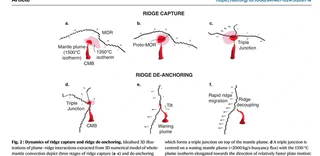
It has long been recognised that spreading ridges are kept in place by competing subduction forces that drive plate motions. Asymmetric strain rates pull spreading ridges in the direction of the strongest slab pull force, which partially explains why spreading ridges can migrate vast distances. However, the interaction between mantle plumes and spreading ridges plays a relatively unknown role on the evolution of plate boundaries. Using a numerical model of mantle convection, we show that plumes with high buoyancy flux (>3000 kg/s) can capture spreading ridges within a 1000 km radius and anchor them in place. Exceptionally high buoyancy fluxes may fragment the overriding plate into smaller plates to accommodate more efficient plate motion. If the plume buoyancy flux wanes below 1000 kg/s the ridge may be de-anchored, leading to rapid ridge migration rates when combined with asymmetric plate boundary forces. Our results show that plume-ridge de-anchoring may have contributed to the rapid migration of the SE Indian Ridge from 43 million years ago due to waning buoyancy flux from the Kerguelen plume.
Type
Publication
Nature Communications
publications

Plain Language Summary

Mid-ocean ridges — the vast underwater mountain chains where new ocean floor is created — are not fixed in place. Over millions of years, they can migrate thousands of kilometres across the ocean basins. Scientists have traditionally explained this movement by the pulling forces of subducting plates on either side of a ridge, but this study reveals that hot mantle plumes rising from deep within the Earth also play a critical role.

Using computer simulations of mantle convection, the researchers show that powerful mantle plumes can effectively capture and anchor a spreading ridge in place, preventing it from migrating. However, if the plume weakens over time, it releases its grip on the ridge — a process the authors call “de-anchoring” — allowing the ridge to suddenly migrate rapidly, especially when combined with uneven pulling forces from subduction zones on either side.

The study applies this mechanism to explain the rapid migration of the Southeast Indian Ridge starting around 43 million years ago, linking it to the waning strength of the Kerguelen mantle plume. This new mechanism has global implications for understanding how plate boundaries evolve near mantle plumes and why spreading ridges sometimes shift abruptly after long periods of stability.

Dr. Ben Mather
Authors
ARC Industry Research Fellow

I am an ARC Industry Research Fellow in the School of Geography, Earth and Atmospheric Sciences at The University of Melbourne. I am an expert in fusing Earth evolution models with data to understand how groundwater moves critical minerals through the landscape. Related research interests include the cycling of volatiles within the Earth, probabilistic thermal models of the lithosphere to unravel past tectonic and climatic events, and understanding the how enigmatic volcanoes form.

I am a vocal advocate for the integral role of geoscience in responding to challenges we face in transitioning to the carbon-neutral economy. As an expert in my field, I have been interviewed in national and international print media, TV, and radio on a wide variety of subjects including earthquakes, volcanoes, groundwater, and critical minerals.

Maria Seton
Authors
Associate Professor & Associate Head of Research
Maria Seton is a marine geoscientist and core member of the EarthByte Group, specialising in global tectonics, geodynamics, and the link between plate tectonic and mantle processes. She develops and uses the GPlates plate reconstruction software.
Simon Williams
Authors
ARC Future Fellow
Simon Williams is a geophysicist specialising in gravity and magnetic data analysis to define sedimentary basins and understand plate tectonics. Previously a long-standing member of the EarthByte Group, he now leads marine geoscience research at IMAS.
Joanne Whittaker
Authors
Associate Professor
Joanne Whittaker uses marine geophysical and geological datasets to study the interaction between upper mantle convection and surface plate tectonics.
Rebecca Carey
Authors
Associate Professor
Rebecca Carey investigates subaerial and submarine volcanic eruptions, with particular interest in how water depth influences eruption explosivity.
Maëlis Arnould
Authors
Assistant Professor
Maëlis Arnould develops 3D spherical models of mantle convection with self-generating plate tectonics to study interactions between lithosphere and mantle dynamics.
Nicolas Coltice
Authors
Professor
Nicolas Coltice uses 3D spherical numerical geodynamic models to study how mantle convection drives plate tectonics, treating the mantle-lithosphere as a single coupled system.
Robert Duncan
Authors
Professor Emeritus
Robert Duncan specialises in 40Ar/39Ar geochronology and geochemistry of ocean floor and oceanic island basalts to model crustal movements and mantle plume dynamics.