Solid Earth Carbon Degassing and Sequestration Since 1 Billion Years Ago
Plain Language Summary
Over billions of years, the Earth’s climate has swung between extreme ice ages and hothouse conditions. A major driver of these shifts is the amount of carbon dioxide (CO₂) released into the atmosphere by volcanic and tectonic processes — and how much carbon is locked away into oceanic plates. This study builds the most comprehensive model yet of how solid Earth carbon emissions and sequestration have varied over the past one billion years.
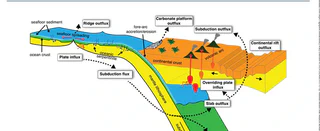
By combining a plate tectonic model with reconstructions of carbon stored in oceanic plates and a thermodynamic model of what happens when those plates are subducted, the researchers track the balance between CO₂ being released at mid-ocean ridges, rifts, and volcanic arcs, and carbon being locked into oceanic sediments and crust. The results reveal that several major climate transitions — including the Snowball Earth glaciations around 700 million years ago — coincide with significant drops in tectonic CO₂ outgassing.
The study also shows that hothouse climates in the Cambrian, Silurian/Devonian, and Triassic-Jurassic periods align with reduced carbon sequestration into oceanic plates, while the late Cenozoic cooling trend correlates with declining ridge and rift degassing and a surge in carbon burial in deep-sea sediments. These findings provide new boundary conditions for understanding how Earth’s climate has been regulated by plate tectonics over deep time.