Regional carbonate compensation depth variability in the Pacific Ocean since the Oligocene

Jun 1, 2025·
Faranak Dalvand
Adriana Dutkiewicz
Adriana Dutkiewicz
Nicky M. Wright
Nicky M. Wright
Dr. Ben Mather
Dr. Ben Mather
R. Dietmar Müller
R. Dietmar Müller
· 2 min read
Abstract
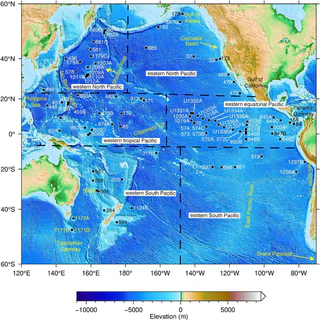
Deep-sea carbonates constitute the primary deep carbon reservoir, playing a critical role in regulating the long-term global carbon cycle. Reconstructing the temporal evolution of carbonate flux to the seafloor requires estimating the changes in carbonate compensation depth (CCD), a key proxy, revealing the depth where the rate of calcium carbonate supply from biogenic ooze equals the rate of dissolution. However, regional CCD estimates across the Pacific, the deepest and largest ocean basin, remain poorly constrained, except for the eastern equatorial region. Here, we present six new regional reconstructions of the CCD across the Pacific Ocean, using a linear reduced major-axis regression of the carbonate accumulation rate (CAR) versus paleo-water depth, that include the effects of dynamic topography and eustasy. The CCDs show significant fluctuations of ~1–1.2 km across the Pacific over the Neogene. Regional CCD models since the early Miocene suggest the influence of climate perturbations, Antarctic ice-sheet growth, and Pacific gateway reorganization on Pacific deep-water circulation and carbonate production.
Type
Publication
Frontiers in Earth Science
publications

Plain Language Summary

The deep ocean floor acts as a massive carbon warehouse, storing vast amounts of carbon in the form of calcium carbonate shells from tiny marine organisms that sink to the seafloor after they die. But this carbon is only preserved above a certain depth — below the carbonate compensation depth (CCD), the water becomes so corrosive that it dissolves carbonate faster than it accumulates. The CCD therefore acts like a chemical boundary that controls how much carbon the deep ocean can store.

This study produces six new regional reconstructions of how the CCD has changed across the Pacific Ocean — the world’s deepest and largest ocean basin — over the past 30 million years. The results reveal that the CCD has fluctuated by more than a kilometre in some regions, driven by changes in climate, the growth and retreat of Antarctic ice sheets, and the reorganisation of ocean gateways that control deep-water circulation.

Notably, the western Pacific CCD shows a distinct deepening around 24 million years ago, interpreted as a delayed response to the expansion of the West Antarctic ice sheet. The study also identifies the well-known late Miocene “carbonate crash” and “biogenic bloom” events in both the western and eastern equatorial Pacific, but with a roughly one million year time lag in the west. These findings provide new insights into how regional ocean chemistry responds to global climate change and can help improve models of the long-term carbon cycle.

Authors
PhD Candidate
Faranak Dalvand’s research focuses on reconstructing the evolution of carbonate compensation depth and carbonate flux to the seafloor across the Pacific and Indian Oceans.
Adriana Dutkiewicz
Authors
Associate Professor
Adriana Dutkiewicz is a sedimentologist in the EarthByte Group who uses scientific ocean drilling data to understand deep-sea circulation and carbon reservoirs over geological time. She is the first woman to receive the Australian Academy of Science’s Mawson Medal.
Nicky M. Wright
Authors
ARC Early Career Industry Fellow
Nicky Wright is a marine geoscientist and palaeoclimate researcher who reconstructs past Earth surface elevation, with expertise in plate tectonics, past ocean circulation, and long-term sea level change. She is a Superstar of STEM (2023-2024).
Dr. Ben Mather
Authors
ARC Industry Research Fellow

I am an ARC Industry Research Fellow in the School of Geography, Earth and Atmospheric Sciences at The University of Melbourne. I am an expert in fusing Earth evolution models with data to understand how groundwater moves critical minerals through the landscape. Related research interests include the cycling of volatiles within the Earth, probabilistic thermal models of the lithosphere to unravel past tectonic and climatic events, and understanding the how enigmatic volcanoes form.

I am a vocal advocate for the integral role of geoscience in responding to challenges we face in transitioning to the carbon-neutral economy. As an expert in my field, I have been interviewed in national and international print media, TV, and radio on a wide variety of subjects including earthquakes, volcanoes, groundwater, and critical minerals.

R. Dietmar Müller
Authors
Professor of Geophysics
Dietmar Müller leads the EarthByte Group and is a Fellow of the Australian Academy of Science. His research focuses on plate tectonics, geodynamics, and the development of the GPlates software for producing open-access models of Earth’s dynamic history.