Subducting seafloor anomalies promote porphyry copper formation
Plain Language Summary
Porphyry copper deposits — the world’s most important source of copper — form in volcanic arcs above subduction zones. But not all subduction zones produce copper deposits equally. This study investigates why some sections of subduction zones are more productive than others, focusing on the role of unusual features on the ocean floor that get recycled into the Earth’s interior.
The ocean floor is not uniform — it is marked by seamounts, large igneous provinces, and fracture zones that differ chemically and physically from normal oceanic crust. When these features are subducted, they carry extra water and other volatile compounds into the mantle, which can oxidise the overlying mantle wedge and create conditions favourable for concentrating copper in magmatic systems.
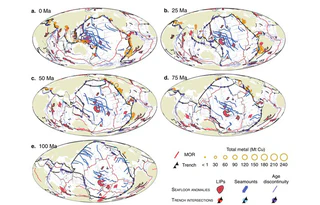
Using plate tectonic reconstructions spanning the last 100 million years and a machine learning model trained on known porphyry copper deposit locations, the study finds a strong correlation between the subduction of seafloor anomalies and the formation of copper deposits, especially along the Cordillera of the Americas. While thick continental crust (greater than 45 km) is a necessary condition, it is not sufficient on its own — the subduction of chemically enriched seafloor features appears to provide the additional ingredients needed to form economically significant copper deposits.