Subducting seafloor anomalies promote porphyry copper formation

Jan 1, 2025·
Dr. Ben Mather
Dr. Ben Mather
R. Dietmar Müller
R. Dietmar Müller
Christopher P. Alfonso
Nicky M. Wright
Nicky M. Wright
Maria Seton
Maria Seton
· 1 min read
Abstract
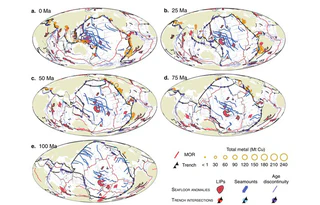
Oceanic seafloor is scarred by age discontinuities, seamounts, and large igneous provinces (LIPs) over normal bathymetry. The recycling of these seafloor anomalies has been speculated to alter subduction regimes which may locally prime some regions for porphyry copper deposit formation. Using a tectonic plate reconstruction encompassing the last 100 Ma paired with a machine learning classifier trained on known porphyry copper deposits, we find that all porphyry systems require >45 km thick continental crust and a combination of plate tectonic features that is regionally variable, but this alone does not guarantee Cu-porphyry deposit formation. We find that the subduction of tectonic and volcanic features is well correlated with mineral emplacement, particularly along the American Cordillera. Seafloor anomalies have higher degrees of hydrothermal alteration and serpentinization compared to normal seafloor, resulting in enhanced oxidation of the sub-arc mantle upon their subduction due to the increased slab outflux of volatiles.
Type
Publication
International Geology Review
publications

Plain Language Summary

Porphyry copper deposits — the world’s most important source of copper — form in volcanic arcs above subduction zones. But not all subduction zones produce copper deposits equally. This study investigates why some sections of subduction zones are more productive than others, focusing on the role of unusual features on the ocean floor that get recycled into the Earth’s interior.

The ocean floor is not uniform — it is marked by seamounts, large igneous provinces, and fracture zones that differ chemically and physically from normal oceanic crust. When these features are subducted, they carry extra water and other volatile compounds into the mantle, which can oxidise the overlying mantle wedge and create conditions favourable for concentrating copper in magmatic systems.

Using plate tectonic reconstructions spanning the last 100 million years and a machine learning model trained on known porphyry copper deposit locations, the study finds a strong correlation between the subduction of seafloor anomalies and the formation of copper deposits, especially along the Cordillera of the Americas. While thick continental crust (greater than 45 km) is a necessary condition, it is not sufficient on its own — the subduction of chemically enriched seafloor features appears to provide the additional ingredients needed to form economically significant copper deposits.

Dr. Ben Mather
Authors
ARC Industry Research Fellow

I am an ARC Industry Research Fellow in the School of Geography, Earth and Atmospheric Sciences at The University of Melbourne. I am an expert in fusing Earth evolution models with data to understand how groundwater moves critical minerals through the landscape. Related research interests include the cycling of volatiles within the Earth, probabilistic thermal models of the lithosphere to unravel past tectonic and climatic events, and understanding the how enigmatic volcanoes form.

I am a vocal advocate for the integral role of geoscience in responding to challenges we face in transitioning to the carbon-neutral economy. As an expert in my field, I have been interviewed in national and international print media, TV, and radio on a wide variety of subjects including earthquakes, volcanoes, groundwater, and critical minerals.

R. Dietmar Müller
Authors
Professor of Geophysics
Dietmar Müller leads the EarthByte Group and is a Fellow of the Australian Academy of Science. His research focuses on plate tectonics, geodynamics, and the development of the GPlates software for producing open-access models of Earth’s dynamic history.
Christopher P. Alfonso
Authors
PhD Graduate, EarthByte Group
Christopher Alfonso completed his PhD in Geophysics at the University of Sydney, researching the use of spatio-temporal data mining and machine learning to understand the formation of major mineral deposits, particularly porphyry copper systems.
Nicky M. Wright
Authors
ARC Early Career Industry Fellow
Nicky Wright is a marine geoscientist and palaeoclimate researcher who reconstructs past Earth surface elevation, with expertise in plate tectonics, past ocean circulation, and long-term sea level change. She is a Superstar of STEM (2023-2024).
Maria Seton
Authors
Associate Professor & Associate Head of Research
Maria Seton is a marine geoscientist and core member of the EarthByte Group, specialising in global tectonics, geodynamics, and the link between plate tectonic and mantle processes. She develops and uses the GPlates plate reconstruction software.