Carbon emissions along divergent plate boundaries modulate icehouse-greenhouse climates
Plain Language Summary
Earth’s climate has alternated between warm “greenhouse” periods and cold “icehouse” periods over hundreds of millions of years. A major factor in these swings is the amount of carbon dioxide (CO₂) released by volcanic and tectonic activity versus the amount stored away in oceanic rocks and sediments. But which tectonic processes matter most has been debated for decades.
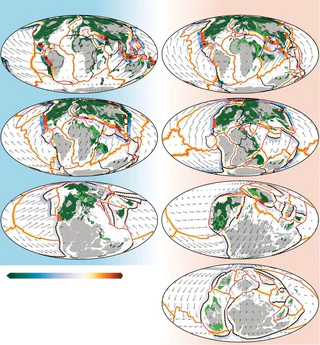
This study reveals that the balance between CO₂ emissions from all volcanic sources — including mid-ocean ridges, continental rifts, and volcanic arcs — and carbon being locked into the oceanic plates is what drives the big climate shifts. During greenhouse periods, total volcanic emissions outpace carbon sequestration; during icehouse periods, the oceans absorb and store more carbon than volcanoes release. Crucially, the study challenges the long-standing assumption that volcanic arcs above subduction zones are the dominant source of tectonic CO₂.
Before 100 million years ago, CO₂ emissions from mid-ocean ridges and continental rifts — where tectonic plates pull apart — actually exceeded arc emissions, making divergent plate boundaries the primary driver of atmospheric carbon. This finding fundamentally reshapes our understanding of how plate tectonics has regulated Earth’s climate through geological time and provides critical new constraints for models of the long-term carbon cycle.