Adjoint inversion of geothermal potential in Ireland assimilating surface heat flow, seismic velocity, and Curie depth
Apr 9, 2018 · 1 min read
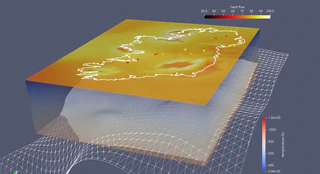
3D thermal model of Ireland assimilating Curie depth and surface heat flow data
Abstract
Temperature models for assessing geothermal potential are usually concerned with the upper 5 km of the crust. The configuration of deeper crustal lithologies, and the thermo-chemical properties assigned to them, greatly affects temperature variation in the upper crust, but are highly uncertain. We pose an inverse problem that integrates surface heat flow observations, seismic velocities, and Curie depth to constrain upper crustal temperature in Ireland. From our inversions we can retrieve information on boundary conditions, crustal heat production, and thermal conductivity. We quantify the uncertainty of these thermo-chemical properties to produce statistically robust temperature models of the crust. The uncertainty of the temperature field in the upper crust directly controls whether a geothermal resource is viable. In Ireland there is a gradual increase in surface heat flow from SW to NE based on limited heat flow data. However, we determine that the heat production of felsic bodies contribute a more significant amount of heat to the upper crust, despite relatively high uncertainty.
Date
Apr 9, 2018 5:30 PM — 7:00 PM
Location

Vienna, Austria

events

Poster presentation.

Dr. Ben Mather
Authors
ARC Industry Research Fellow

I am an ARC Industry Research Fellow in the School of Geography, Earth and Atmospheric Sciences at The University of Melbourne. I am an expert in fusing Earth evolution models with data to understand how groundwater moves critical minerals through the landscape. Related research interests include the cycling of volatiles within the Earth, probabilistic thermal models of the lithosphere to unravel past tectonic and climatic events, and understanding the how enigmatic volcanoes form.

I am a vocal advocate for the integral role of geoscience in responding to challenges we face in transitioning to the carbon-neutral economy. As an expert in my field, I have been interviewed in national and international print media, TV, and radio on a wide variety of subjects including earthquakes, volcanoes, groundwater, and critical minerals.