All models are wrong: Testing your assumptions (keynote)

Nov 1, 2019·
Dr. Ben Mather
Dr. Ben Mather
· 0 min read
Abstract
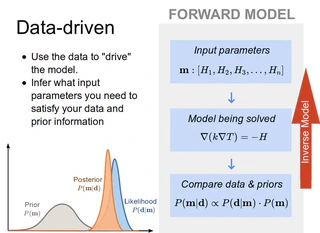
With the rapid explosion in big data comes an entourage of tools to help interrogate those data – however these methods are often shrouded in mystery. As scientists we often use models to explain our observations, but what if we flip that around and we use the data to inform our models? Bayes’ theorem formally describes the intersection of our observations, the model we are solving, and any prior knowledge we have about the problem. Simply approaching earth science problems in a “data-driven” philosophy can help glean new insights into our problem and quantify uncertainty and internal relationships within our dataset or model. Often it is not just a single “optimal” model we are searching for, rather to quantify its uncertainty is much more desirable. In this talk, I will draw on case studies from thermal modelling and tectonic plate reconstructions to demonstrate how inference can be useful.
Date
Nov 1, 2019 3:00 PM — 3:30 PM
Location

UNSW, Sydney

events
Dr. Ben Mather
Authors
ARC Industry Research Fellow

I am an ARC Industry Research Fellow in the School of Geography, Earth and Atmospheric Sciences at The University of Melbourne. I am an expert in fusing Earth evolution models with data to understand how groundwater moves critical minerals through the landscape. Related research interests include the cycling of volatiles within the Earth, probabilistic thermal models of the lithosphere to unravel past tectonic and climatic events, and understanding the how enigmatic volcanoes form.

I am a vocal advocate for the integral role of geoscience in responding to challenges we face in transitioning to the carbon-neutral economy. As an expert in my field, I have been interviewed in national and international print media, TV, and radio on a wide variety of subjects including earthquakes, volcanoes, groundwater, and critical minerals.