Bayesian inversion of 3D groundwater flow within the Sydney-Gunnedah-Bowen Basin (keynote)
Feb 11, 2021 · 0 min read
Abstract
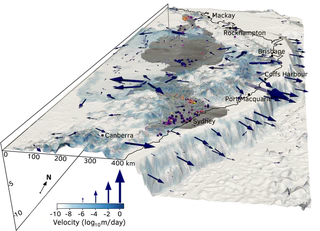
In the driest inhabited continent on Earth, aquifers of the Sydney-Gunnedah-Bowen Basin are essential for Australian agriculture production, yet they experience progressively declining water level trends. In addition, groundwater discharge from the basin into the coastal ocean, a process now widely recognised as being important for providing significant inputs of nutrients and solutes to the oceans, has never been modelled. We have constructed a 3D Bayesian numerical groundwater flow model spanning the entire width and depth of this continent-scale basin. Our model assimilates groundwater recharge rates from water chloride concentrations, and borehole temperature measurements to constrain hydrothermal flow within the basin. We show that inland aquifers exhibit slow flow rates of 0.5 cm/day, resulting in a groundwater residence time of approximately 383 thousand years. In contrast, coastal aquifers have flow rates of approximately 30 cm/day, and a groundwater residence time of just 182 years. Our open-source modelling approach can be extended to any basin and help inform policies on the sustainable management of groundwater. In the future, our approach will enable time-dependent modelling of groundwater flow in response to uplift, erosion and climate change.
Date
Feb 11, 2021 2:30 PM — 2:50 PM
Location

University of Tasmania

events
Dr. Ben Mather
Authors
ARC Industry Research Fellow

I am an ARC Industry Research Fellow in the School of Geography, Earth and Atmospheric Sciences at The University of Melbourne. I am an expert in fusing Earth evolution models with data to understand how groundwater moves critical minerals through the landscape. Related research interests include the cycling of volatiles within the Earth, probabilistic thermal models of the lithosphere to unravel past tectonic and climatic events, and understanding the how enigmatic volcanoes form.

I am a vocal advocate for the integral role of geoscience in responding to challenges we face in transitioning to the carbon-neutral economy. As an expert in my field, I have been interviewed in national and international print media, TV, and radio on a wide variety of subjects including earthquakes, volcanoes, groundwater, and critical minerals.