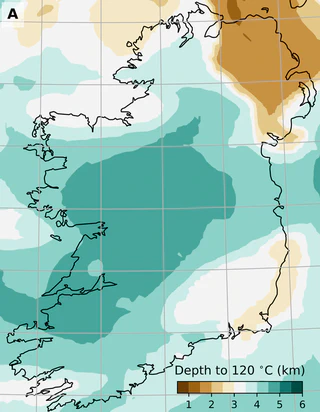
G.O.THERM Project: an integrated approach to probe the deep thermal structure of Ireland

Nov 6, 2018·
Dr. Ben Mather
Dr. Ben Mather
,
Thomas Farrell
Javier Fullea
Javier Fullea
· 0 min read
Abstract
With the backdrop of climate change and Ireland’s reliance on fossil fuels, the need to exploit Ireland’s potential for secure, reliable and diverse indigenous renewable energy supply is immediate. The contribution of geothermal energy to the required energy transformation of Ireland has fallen behind targets and is far from realising its full potential. As a guide to geothermal conditions beneath our feet, Ireland’s current maps of temperature within the subsurface are based on unrealistic assumptions and only a few shallow borehole temperature measurements. G.O.THERM.3D proposes a novel approach to quantify and map temperature in Ireland’s crust in an integrated approach that simultaneously accounts for multiple geophysical and petrological datasets. Based on this integrative approach a new 3D temperature atlas for Ireland’s crust will be built from the bottom up. The 3D temperature model will provide an insight into the thermal regime within Ireland’s subsurface, offering a robust constraint on future quantitative modelling of both shallow and deep geothermal prospects across the country. The temperature model and its associated data will be made publicly available for the community on an interactive online platform and the main results will be presented in national and international conferences as well as outreach events to increase public awareness of geothermal energy. The outcomes of this project should assist in the development of public policy on geothermal energy exploration, mapping, planning and exploitation.
Date
Nov 6, 2018 10:30 AM — 11:00 AM
Location

Geological Survey of Ireland, Beggar’s Bush

events
Dr. Ben Mather
Authors
ARC Industry Research Fellow

I am an ARC Industry Research Fellow in the School of Geography, Earth and Atmospheric Sciences at The University of Melbourne. I am an expert in fusing Earth evolution models with data to understand how groundwater moves critical minerals through the landscape. Related research interests include the cycling of volatiles within the Earth, probabilistic thermal models of the lithosphere to unravel past tectonic and climatic events, and understanding the how enigmatic volcanoes form.

I am a vocal advocate for the integral role of geoscience in responding to challenges we face in transitioning to the carbon-neutral economy. As an expert in my field, I have been interviewed in national and international print media, TV, and radio on a wide variety of subjects including earthquakes, volcanoes, groundwater, and critical minerals.

Authors
Researcher
Thomas Farrell investigates Ireland’s subsurface thermal structure and geothermal energy potential through probabilistic heat flow modelling and magnetotelluric data analysis.
Javier Fullea
Authors
Professor of Geophysics
Javier Fullea specialises in integrated geophysical-petrological modelling of the lithosphere and upper mantle. He is a key developer of the LitMod software for 3D lithospheric imaging and the WINTERC-G global thermochemical model.