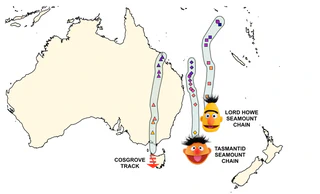
Slab-induced plume branching connects parallel hotspot chains

Oct 1, 2021·
Dr. Ben Mather
Dr. Ben Mather
Maria Seton
Maria Seton
Simon Williams
Simon Williams
Joanne Whittaker
Joanne Whittaker
Rebecca Carey
Rebecca Carey
Maëlis Arnould
Maëlis Arnould
Nicolas Coltice
Nicolas Coltice
Angus Rogers
Angus Rogers
Saskia Ruttor
Saskia Ruttor
Oliver Nebel
Oliver Nebel
· 0 min read
Abstract
We propose that slab-induced plume branching can explain the formation of parallel hotspot chains observed in the oceanic and continental record. Using plate tectonic reconstructions and geodynamic modelling, we demonstrate how subducting slabs deflect and split mantle plumes in the transition zone, generating multiple branches that produce parallel volcanic tracks at the surface.
Date
Oct 1, 2021 1:00 PM — 1:00 PM
Location

Online

events
Dr. Ben Mather
Authors
ARC Industry Research Fellow

I am an ARC Industry Research Fellow in the School of Geography, Earth and Atmospheric Sciences at The University of Melbourne. I am an expert in fusing Earth evolution models with data to understand how groundwater moves critical minerals through the landscape. Related research interests include the cycling of volatiles within the Earth, probabilistic thermal models of the lithosphere to unravel past tectonic and climatic events, and understanding the how enigmatic volcanoes form.

I am a vocal advocate for the integral role of geoscience in responding to challenges we face in transitioning to the carbon-neutral economy. As an expert in my field, I have been interviewed in national and international print media, TV, and radio on a wide variety of subjects including earthquakes, volcanoes, groundwater, and critical minerals.

Maria Seton
Authors
Associate Professor & Associate Head of Research
Maria Seton is a marine geoscientist and core member of the EarthByte Group, specialising in global tectonics, geodynamics, and the link between plate tectonic and mantle processes. She develops and uses the GPlates plate reconstruction software.
Simon Williams
Authors
ARC Future Fellow
Simon Williams is a geophysicist specialising in gravity and magnetic data analysis to define sedimentary basins and understand plate tectonics. Previously a long-standing member of the EarthByte Group, he now leads marine geoscience research at IMAS.
Joanne Whittaker
Authors
Associate Professor
Joanne Whittaker uses marine geophysical and geological datasets to study the interaction between upper mantle convection and surface plate tectonics.
Rebecca Carey
Authors
Associate Professor
Rebecca Carey investigates subaerial and submarine volcanic eruptions, with particular interest in how water depth influences eruption explosivity.
Maëlis Arnould
Authors
Assistant Professor
Maëlis Arnould develops 3D spherical models of mantle convection with self-generating plate tectonics to study interactions between lithosphere and mantle dynamics.
Nicolas Coltice
Authors
Professor
Nicolas Coltice uses 3D spherical numerical geodynamic models to study how mantle convection drives plate tectonics, treating the mantle-lithosphere as a single coupled system.
Angus Rogers
Authors
Postdoctoral Researcher
Angus Rogers researches the chemical and geodynamic complexities of oceanic volcanism in the southwest Pacific and eastern Australia, with expertise in isotope geochemistry, U-Th-Pb dating, and ocean island basalts.
Saskia Ruttor
Authors
Postdoctoral Researcher
Saskia Ruttor uses radiogenic and stable isotopes to investigate the evolution of oceanic islands and mantle plume dynamics, with published work on the Pitcairn mantle plume, Hawaiian lavas, and Azores basalts.
Oliver Nebel
Authors
Professor of Geochemistry
Oliver Nebel is a high-temperature geochemist who uses rock and mineral chemistry, and stable and radiogenic isotope compositions, to study mantle composition, ocean floor volcanic activity, and crust-mantle evolution. He directs the Monash Isotopia Laboratory.