The origin of intraplate mafic volcanism along the eastern margin of Australia

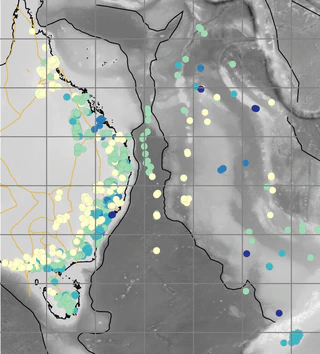 Spatial and temporal distribution of eruption points in Eastern Australia and offshore
Vienna, Austria
Overview
The eastern margin of Australia has experienced extensive mafic volcanism since its breakaway from Antarctica (~ 80 Ma). A plume origin has been suggested for intraplate volcanism, however, the timing and location of eruption points does not clearly correlate with Australia’s northward motion of 5-8cm/yr. That Cenozoic volcanism coincides with dynamically supported topography of up to 1km throughout the eastern highlands suggests a complex interaction between a mantle plume and lithospheric geometry as Australia migrated northward.
Spatial and temporal distribution of volcanics
Volcanism has progressed inland covering a larger surface area of Eastern Australia. Central volcanoes and a leucitite suite can be tracked to the northward motion of the Australian plate, whereas lava fields exhibit no age progression. While volcanism at the sourthern margin can be attributed to edge-driven convective response to lithospheric geometry, the provenance of volcanism along the eastern margin remains elusive.
Rates of subduction and slab volume consumption
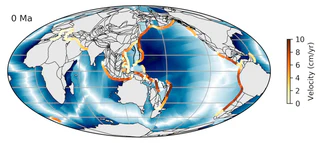
Rates of convergence have gradually increased throughout the Cenozoic along the Tonga-Kermadec Trench, which transitions to subduction that is congested by the Hikurangi Plateau along the Hikurangi Trench and then to micro-continent collision along the Alpine Fault in New Zealand. In addition to the remnant East Gondwanan slab, the subducting oceanic lithosphere since the breakaway of Australia from Antarctica has been consumed progressively eastward. If partial melting of remnant slabs occurred in this time, then this region would have a fertile mantle and prone to volcanism.
Zealandia: the missing piece?
That spikes in non-age progressive volcanism occur on both continental and oceanic crust has widespread implications for a combination of mantle heterogeneity, subduction dynamics, and stress regimes. An expidition aboard the RV Investigator to collect samples from Zealandia will insights to these processes.

I am an ARC Industry Research Fellow in the School of Geography, Earth and Atmospheric Sciences at The University of Melbourne. I am an expert in fusing Earth evolution models with data to understand how groundwater moves critical minerals through the landscape. Related research interests include the cycling of volatiles within the Earth, probabilistic thermal models of the lithosphere to unravel past tectonic and climatic events, and understanding the how enigmatic volcanoes form.
I am a vocal advocate for the integral role of geoscience in responding to challenges we face in transitioning to the carbon-neutral economy. As an expert in my field, I have been interviewed in national and international print media, TV, and radio on a wide variety of subjects including earthquakes, volcanoes, groundwater, and critical minerals.