The Role of Stagnant Slabs at the Transition Zone on Widespread Volcanism in Eastern Australia and Zealandia

Dec 11, 2019·
Dr. Ben Mather
Dr. Ben Mather
,
Dietmar Muller
Maria Seton
Maria Seton
Nick Mortimer
Nick Mortimer
Saskia Ruttor
Saskia Ruttor
· 0 min read
Abstract
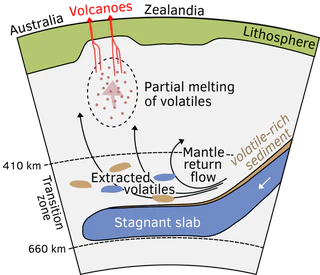
The eastern margin of Australia and Zealandia has experienced extensive mafic volcanism since Australia broke away from Antarctica approximately 80 million years ago. A plume origin has been proposed for age-progressive volcanism observed on the continent and offshore. These are, however, the exceptions - the majority of eruptions in the region exhibit no clear age progression. From our plate reconstruction of the Australia-Zealandia region over the last 80 million years that has most likely accumulated at the transition zone. Anomalous mantle has previously been identified from isotopic analysis on a limited set of samples. Our expanded dataset comparing 143Nd/144Nd and 206Pb/204Pb isotopic ratios favour a high degree of lithospheric interaction that is increasingly more pronounced at high latitudes. Compilations of P and S-wave tomography add further support for an anomalous transition zone in the region. We propose that widespread, non-age progressive volcanism results from sporadic upwellings triggered by changes in plate kinematics which entrains stagnant subducted material at the transition zone. The most pronounced pulse of volcanism occurs at 23 Ma and coincides with an abrupt increase in plate velocity and subduction flux. This provides a framework through which to explain non-age progressive volcanism in a region of anomalous mantle composition.
Date
Dec 11, 2019 2:00 PM — 6:00 PM
Location

San Francisco, Moscone South

events
Dr. Ben Mather
Authors
ARC Industry Research Fellow

I am an ARC Industry Research Fellow in the School of Geography, Earth and Atmospheric Sciences at The University of Melbourne. I am an expert in fusing Earth evolution models with data to understand how groundwater moves critical minerals through the landscape. Related research interests include the cycling of volatiles within the Earth, probabilistic thermal models of the lithosphere to unravel past tectonic and climatic events, and understanding the how enigmatic volcanoes form.

I am a vocal advocate for the integral role of geoscience in responding to challenges we face in transitioning to the carbon-neutral economy. As an expert in my field, I have been interviewed in national and international print media, TV, and radio on a wide variety of subjects including earthquakes, volcanoes, groundwater, and critical minerals.

Maria Seton
Authors
Associate Professor & Associate Head of Research
Maria Seton is a marine geoscientist and core member of the EarthByte Group, specialising in global tectonics, geodynamics, and the link between plate tectonic and mantle processes. She develops and uses the GPlates plate reconstruction software.
Nick Mortimer
Authors
Emeritus Scientist
Nick Mortimer is best known for defining and characterising Zealandia as Earth’s eighth continent, drawing on decades of research into the tectonic history of the southwest Pacific.
Saskia Ruttor
Authors
Postdoctoral Researcher
Saskia Ruttor uses radiogenic and stable isotopes to investigate the evolution of oceanic islands and mantle plume dynamics, with published work on the Pitcairn mantle plume, Hawaiian lavas, and Azores basalts.