
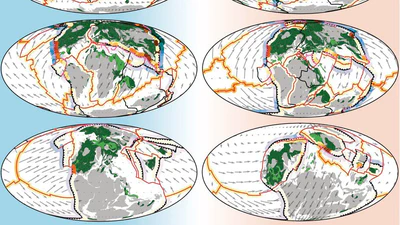
Carbon emissions along divergent plate boundaries modulate icehouse-greenhouse climates
Carbon emissions along divergent plate boundaries modulate icehouse-greenhouse climate transitions through mid-ocean ridge and rift degassing.

I am an ARC Industry Research Fellow in the School of Geography, Earth and Atmospheric Sciences at The University of Melbourne. I am an expert in fusing Earth evolution models with data to understand how groundwater moves critical minerals through the landscape. Related research interests include the cycling of volatiles within the Earth, probabilistic thermal models of the lithosphere to unravel past tectonic and climatic events, and understanding the how enigmatic volcanoes form.
I am a vocal advocate for the integral role of geoscience in responding to challenges we face in transitioning to the carbon-neutral economy. As an expert in my field, I have been interviewed in national and international print media, TV, and radio on a wide variety of subjects including earthquakes, volcanoes, groundwater, and critical minerals.
PhD in Earth Science
The University of Melbourne
Bachelor of Science (Hons)
Monash University
Diploma of Film and Television
Monash University
The University of Melbourne
Fusing Earth evolution models with data to understand how groundwater moves critical minerals through the landscape.
BHP
The University of Sydney
Explore the dynamics of plume-ridge and plume-slab interaction
Sydney Informatics Hub
Coupling of geodynamic codes with surface processes and groundwater flow.
Dublin Institute for Advanced Studies
3D integrated geothermal modelling of Ireland.
The University of Melbourne
Developer of Quagmire, a code for parallel surface processes modelling.
The University of Melbourne
Monash University
Monash University
Carbon emissions along divergent plate boundaries modulate icehouse-greenhouse climate transitions through mid-ocean ridge and rift degassing.
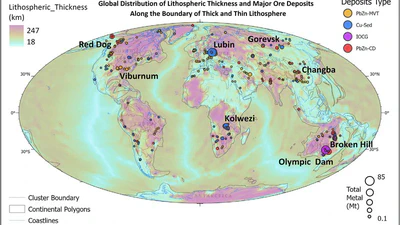
Using full-waveform seismic tomography to detect craton boundaries and their spatial links to critical metal deposit locations.

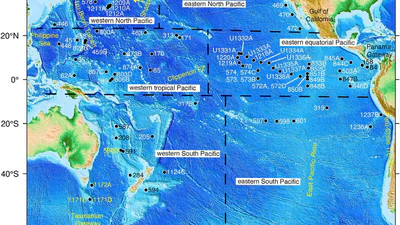
Reconstructing regional carbonate compensation depth variability in the Pacific Ocean since the Oligocene to understand deep-sea carbon cycling.
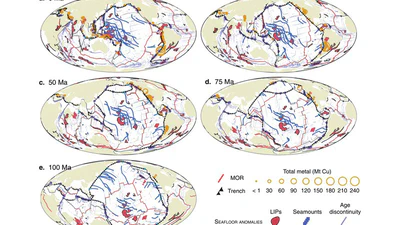
Plate tectonic reconstructions and machine learning show that subducting seafloor anomalies promote porphyry copper deposit formation.
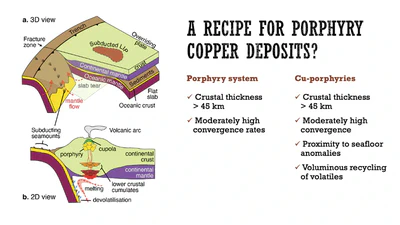
“With copper demand projected to increase by 350% by 2050 for renewable energy and electric vehicles, understanding the formation of porphyry copper deposits is critical. We …
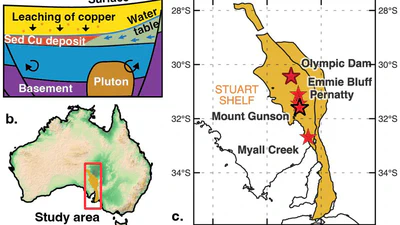
An update on the 'Go with the flow' project — an ARC Industry Research Fellowship with BHP that combines continent-scale groundwater modelling with copper exploration to find new …
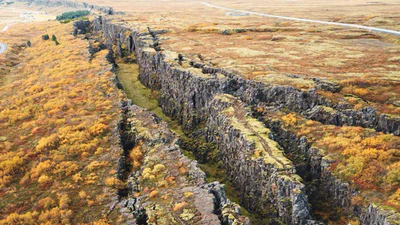
New research published in Communications Earth & Environment shows that the balance between volcanic outgassing and carbon sequestration into oceanic lithosphere is the key driver …
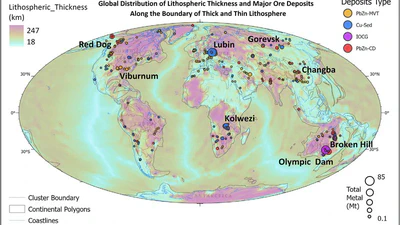
Our new paper in Geoscience Frontiers uses full-waveform seismic tomography and machine learning to map craton boundaries worldwide — and shows that 85% of target mineral deposits …